Sciurus niger
| Eastern Fox Squirrel
(Sciurus niger) | |
|---|---|
| Range | |
 | |
| Taxonomic classification | |
| Order: | Rodentia |
| Suborder: | Sciuromorpha |
| Family: | Sciuridae |
| Subfamily: | Sciurinae |
| Tribe: | Sciurini |
| Genus: | Sciurus |
| Subgenus: | Parasciurus |
| Binomial details | |
| Sciurus niger Linnaeus, 1758 | |
| Other resources | |
| Full taxonomic details at MDD | |
The Eastern Fox Squirrel (Sciurus niger) is a squirrel of variable coloration found in a diversity of deciduous and mixed-forest habitats.
Description
From Koprowski (1994): "Dorsal pelage is variable; fox squirrels from the western and northern portions of the natural range are grizzled with a suffusion of buff to orange. The venter can be white to cinnamon but usually is rufous (Baumgartner, 1943; Flyger and Gates, 1982). Fox squirrels in the southeastern United States are grizzled gray to agouti to black on the dorsum with white or cream nose, ears, and feet, and a black crown and nape (Kiltie, 1992; Moore, 1956; Weigl et al., 1989). Fox squirrels from the central United States coast are silvery gray and may be washed with buff on the hips, feet, and head; tail is pale gray; underparts are white to pale gray but may be cinnamon (Flyger and Gates, 1982). Melanism is common, especially in the southern United States (Kiltie, 1989, 1992). Albinism is rare (Baumgartner, 1943; Moore, 1956)."
.jpg)
External measurements
Length measurements are in millimeters (mm) and weight measurements are in grams (g), unless stated otherwise. If available, the sample size (n=) is provided. If a range is not provided and n= is not given, then the listed measurement represents an average.
| Part of range | Reference | Total length | Tail length | Hindfoot length | Ear length | Mass |
|---|---|---|---|---|---|---|
| Alabama | Best & Dusi (2014) | 593 (526–716) (n=14) | 303 (262–380) (n=14) | 73 (57–78) (n=14) | 30 (27–33) (n=7) | 839 (584–1,047) (n=5) |
| California | Jameson & Peeters (2004) | 475–580 | 220–280 | 51–80 | 26–33 | 590–700 |
| Carolinas, Virginia, Maryland | Webster et al. (1985) | 500–660 | 200–370 | 737–1,200 | ||
| Colorado | Armstrong et al. (2010) | 450–600 | 170–300 | 50–75 | 19–33 | 400–1,100 |
| Minnesota | Hazard (1982) | 510–621 | 220–265 | 68–76 | 22–31 | 633–930 |
| North Dakota | Seabloom et al. (2020) | 550 | 246 | 73 | 28 | 800–900 |
| Texas | Schmidly & Bradley (2016) | 522 | 245 | 72 | 600–1,300 | |
| Virginia | Linzey (1998) | 475–700 | 250–390 | 0.6–1.5 kg |
Color variation
This section shows some of the color variation present in Sciurus niger. The location is provided for reference only. The individual shown does not necessarily represent the only color variant within the local population.
-

Sciurus niger photographed by Gary Eslinger/USFWS. This individual represents a common coloration for the species. -

Sciurus niger photographed by silvaimage in McLean County, Illinois. -

Sciurus niger photographed by Bob Scheidt in Lee County, Florida. -

Sciurus niger photographed by Lucas Pittman in Jefferson County, Florida. -

Sciurus niger photographed by Dominic in Clarksville, Tennessee. -
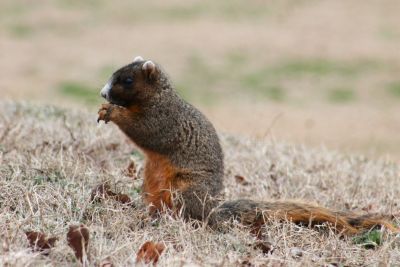
Sciurus niger photographed by Dominic in Clarksville, Tennessee. -

Sciurus niger photographed by Sean Maloney in Elkridge, Maryland. -

Sciurus niger photographed by fireweaver in Austin, Texas. -
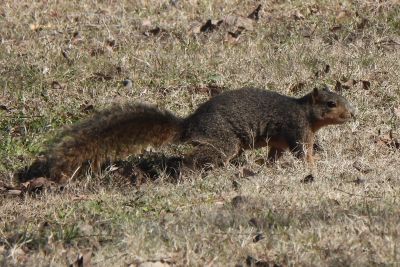
Sciurus niger photographed by Sam Kieschnick in Dallas, Texas. -

Sciurus niger photographed by Andrew Core in Keystone, Florida. -

Sciurus niger photographed by curtis-musson in Jefferson County, Florida. -

Sciurus niger photographed by Leslie S in Longmont, Colorado.


Call
Recordings of the call of Sciurus niger are available on Xeno-canto.
Skull
-

Holotype: USNM 231498. Sciurus niger avicennia. Adult male. Everglades, Lee (Collier) County, Florida. Collected 14 March 1919. Dorsal view of the skull. -

Holotype: USNM 231498. Sciurus niger avicennia. Adult male. Everglades, Lee (Collier) County, Florida. Collected 14 March 1919. Ventral view of the skull. -

Holotype: USNM 231498. Sciurus niger avicennia. Adult male. Everglades, Lee (Collier) County, Florida. Collected 14 March 1919. Lateral view of the skull. -

Holotype: USNM 231498. Sciurus niger avicennia. Adult male. Everglades, Lee (Collier) County, Florida. Collected 14 March 1919. Dorsal view of the mandible. -

Holotype: USNM 231498. Sciurus niger avicennia. Adult male. Everglades, Lee (Collier) County, Florida. Collected 14 March 1919. Lateral view of the left mandible.


Similar species
From Koprowski (1994): "Sciurus niger lacks an upper P3 unlike sympatric congeners, S. aberti, S. carolinensis, S. griseus, and exotic S. aureogaster in Florida. Where sympatric with S. aberti , S. niger lacks hair tufts on the ears, dorsal pelage is not gray, baculum lacks a keel formed by an expanded distal end and is < 16 mm long (Hall, 1981; McGrath 1987). S. carolinensis, the only congener with which geographic overlap is appreciable, is usually >20% smaller in body size, and guard hairs are tipped with white not tawny or orange (Flyger and Gates, 1982). However, S. niger from the eastern United States may have white-tipped guard hairs, but the larger body size of fox squirrels remains evident. Unlike S. griseus, introduced S. niger lacks a gray dorsum, the baculum lacks a distal keel and ventral tuberosity, and the posterior of the jugal is not twisted to reveal the medial surface (Hall, 1981; McGrath, 1987)."
-
Eastern Fox Squirrel (Sciurus niger) -

Abert's Squirrel (Sciurus aberti) observed by Laurens R Halsey in Santa Fe County, New Mexico. -

Arizona Gray Squirrel (Sciurus arizonensis) observed by ronthill in Sierra Vista, Arizona. -

Eastern Gray Squirrel (Sciurus carolinensis) observed by Ben Zerante in Chicago, Illinois. -

Western Gray Squirrel (Sciurus griseus) observed by nutsaboutkitties in San Gabriel Mountains National Monument, California. -

Mexican Fox Squirrel (Sciurus nayaritensis) -
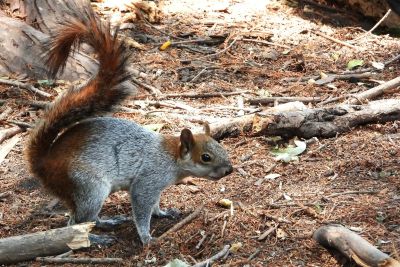
Sciurus aureogaster photographed by rafasl in Parque Ecológico de Xochimilco, Ciudad de México, CDMX, México. This species was introduced to the Florida Keys. Coloration is variable.
Distribution notes
From Koprowski (1994): "Sciurus niger is found in much of the eastern and central United States extending northward into the southern prairie provinces of Canada. The western periphery of the range is expanding along narrow riverine corridors (Adam, 1984; Knapp and Swenson, 1986). Introductions occurred in California, Colorado, Idaho, New Mexico, North Dakota, Oregon, Texas, and Washington in the United States and Ontario in Canada (Flyger and Gates, 1982)."
-

Purple area represents the native range of Sciurus niger published by Koprowski (1994). Pink range is the estimated current distribution of the species based on the work of multiple authors.

References
Adam CIG. 1984. The fox squirrel in Saskatchewan. Blue Jay, 42:241-246.
Armstrong DM, Fitzgerald JP, Meaney CA. 2010. Mammals of Colorado, Second Edition. Denver (CO, USA): University Press of Colorado.
Baumgartner LL. 1943. Pelage studies of fox squirrels (Sciurus niger rufiventer). The American Midland Naturalist 29:588-590.
Best TL, Dusi JL. 2014. Mammals of Alabama (Vol. 4). Tuscaloosa (AL, USA): University Alabama Press.
Flyger V, Gates JE. 1982. Fox and gray squirrels. Pp. 209-229 in Wild mammals of North America (J. A. Chapman and G. A. Feldhamer, eds.). Baltimore (MD< USA): Johns Hopkins University Press.
Hall ER. 1981. The mammals of North America. 2 vols. New York (NY, USA): John Wiley and Sons.
Hazard EB. 1982. The mammals of Minnesota. Minneapolis (MN, USA): University of Minnesota Press.
Jameson EW, Peeters HJ. 2004. Mammals of California (No. 66). Berkeley (CA, USA): University of California Press.
Kiltie RA. 1989. Wildfire and the evolution of dorsal melanism in fox squirrels, Sciurus niger. Journal of Mammalogy 70:726-739.
Kiltie RA. 1992. Camouflage comparisons among fox squirrels from the Mississippi river delta. Journal of Mammalogy 73:906-913.
Knapp SJ, Swenson JE. 1986. New range records for the fox squirrel in the Yellowstone River Drainage, Montana. Prairie Naturalist, 18:128.
Koprowski JL. 1994. Sciurus niger. Mammalian species (479):1-9. https://doi.org/10.2307/3504263
Linzey DW. 1998. The mammals of Virginia. McDonald & Woodward Publishing.
McGrath G. 1987. Relationships of nearctic tree squirrels of the genus Sciurus. Ph.D. dissert., University of Kansas, Lawrence, 101 pp.
McRobie HR, Moncrief ND, Mundy NI. 2019. Multiple origins of melanism in two species of North American tree squirrel (Sciurus). BMC Evolutionary Biology, 19(1):140. https://doi.org/10.1186/s12862-019-1471-7
Moore JC. 1956. Variation in the fox squirrel in Florida. The American Midland Naturalist 55:41-65.
Schmidly DJ, Bradley RD. 2016. The mammals of Texas. Austin (TX, USA): University of Texas Press.
Seabloom R, Hoganson JW, Jensen WF. 2020. The mammals of North Dakota. Fargo (ND, USA): North Dakota State University Press.
Webster WD, Parnell JF, Biggs WC. 1985. Mammals of the Carolinas, Virginia, and Maryland. Chapel Hill (NC, USA): University of North Carolina Press.
Weigl PD, Steele MA, Sherman LJ, HA JC, Sharpe TL. 1989. The ecology of the fox squirrel (Sciurus niger) in North Carolina: implications for survival in the southeast. Bulletin of Tall Timbers Research Station 24:1-93.