Erethizon dorsatum
| North American Porcupine
(Erethizon dorsatum) | |
|---|---|
| Range | |
 | |
| Taxonomic classification | |
| Order: | Rodentia |
| Suborder: | Hystricomorpha |
| Infraorder: | Hystricognathi |
| Superfamily: | Erethizontoidea |
| Family: | Erethizontidae |
| Subfamily: | Erethizontinae |
| Genus: | Erethizon |
| Binomial details | |
| Erethizon dorsatum (Linnaeus, 1758) | |
| Other resources | |
| Full taxonomic details at MDD | |
The North American Porcupine (Erethizon dorsatum) occupies a variety of habitats in much of Canada and the United States and in some parts of northern Mexico.
Description
From Woods (1973): "The genus contains one living species. The body is moderately large, stout, with the upper parts completely covered with long quills. The legs and tail are short. The tail is covered with spines and is not prehensile. The feet are heavy and have naked soles. There are four clawed toes on the front feet, and five clawed toes on the hind feet."


Museum type specimens
-

Holotype: USNM 347446. Erethizon dorsatum dorsatum. Adult female. Piniware River, Labrador, Newfoundland, Canada. Collected 11 April 1935. Dorsal view of the skin. -

Holotype: USNM 347446. Erethizon dorsatum dorsatum. Adult female. Piniware River, Labrador, Newfoundland, Canada. Collected 11 April 1935. Ventral view of the skin.


External measurements
Length measurements are in millimeters (mm) and weight measurements are in grams (g), unless stated otherwise. If available, the sample size (n=) is provided. If a range is not provided and n= is not given, then the listed measurement represents an average.
| Part of range | Reference | Total length | Tail length | Hindfoot length | Ear length | Mass |
|---|---|---|---|---|---|---|
| California | Jameson & Peeters (2004) | 0.79–1.3 m | 145–300 | 75–101 | 25–42 | 10–18 kg |
| Carolinas, Virginia, Maryland | Webster et al. (1985) | 850 | 230 | 4–12 kg; heavy male may exceed 17 kg | ||
| Colorado | Armstrong et al. (2010) | 640–930 | 150–300 | 85–125 | 20–40 | 4–18 kg |
| Minnesota | Hazard (1982) | 612–740 | 160–223 | 75–110 | 30–35 | 5.3–9.1 kg |
| not reported | Best & Dusi (2014) | 790–1,330 | 145–300 | 75–91 | 25–42 | 3.5–18 kg |
| Texas | Schmidly & Bradley (2016) | males: 808; females: 737 | males: 235; females: 230 | males: 98; females: 81 | 5–11 kg | |
| Virginia | Linzey (1998) | 645–1,030 | 145–300 | up to 18 kg |
Skull
-

Holotype: USNM 347446. Erethizon dorsatum dorsatum. Adult female. Piniware River, Labrador, Newfoundland, Canada. Collected 11 April 1935. Dorsal view of the skull. -

Holotype: USNM 347446. Erethizon dorsatum dorsatum. Adult female. Piniware River, Labrador, Newfoundland, Canada. Collected 11 April 1935. Ventral view of the skull. -

Holotype: USNM 347446. Erethizon dorsatum dorsatum. Adult female. Piniware River, Labrador, Newfoundland, Canada. Collected 11 April 1935. Lateral view of the skull. -

Holotype: USNM 347446. Erethizon dorsatum dorsatum. Adult female. Piniware River, Labrador, Newfoundland, Canada. Collected 11 April 1935. Dorsal view of the mandible. -
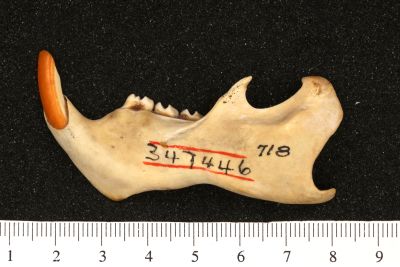
Holotype: USNM 347446. Erethizon dorsatum dorsatum. Adult female. Piniware River, Labrador, Newfoundland, Canada. Collected 11 April 1935. Lateral view of the left mandible.


References
Armstrong DM, Fitzgerald JP, Meaney CA. 2010. Mammals of Colorado, Second Edition. Denver (CO, USA): University Press of Colorado.
Best TL, Dusi JL. 2014. Mammals of Alabama (Vol. 4). Tuscaloosa (AL, USA): University Alabama Press.
Hazard EB. 1982. The mammals of Minnesota. Minneapolis (MN, USA): University of Minnesota Press.
Jameson EW, Peeters HJ. 2004. Mammals of California (No. 66). Berkeley (CA, USA): University of California Press.
Linzey DW. 1998. The mammals of Virginia. McDonald & Woodward Publishing.
Schmidly DJ, Bradley RD. 2016. The mammals of Texas. Austin (TX, USA): University of Texas Press.
Webster WD, Parnell JF, Biggs WC. 1985. Mammals of the Carolinas, Virginia, and Maryland. Chapel Hill (NC, USA): University of North Carolina Press.
Woods CA. 1973. Erethizon dorsatum. Mammalian Species (29):1-6. https://www.jstor.org/stable/3504036