Neotamias cinereicollis
| Gray-collared Chipmunk
(Neotamias cinereicollis) | |
|---|---|
| Range | |
 | |
| Taxonomic classification | |
| Order: | Rodentia |
| Suborder: | Sciuromorpha |
| Family: | Sciuridae |
| Subfamily: | Xerinae |
| Tribe: | Tamiini |
| Genus: | Neotamias |
| Binomial details | |
| Neotamias cinereicollis (J. A. Allen, 1890) | |
| Other resources | |
| Full taxonomic details at MDD | |
The Gray-collared Chipmunk (Neotamias cinereicollis) occupies Ponderosa pine forest and spruce-fir forest of Arizona and New Mexico.
Description
From Hilton and Best (1993): "The gray-collared chipmunk has five black or brown dorsal stripes; the lateral-most pair may be difficult to discern. There are two whitish and three brown facial stripes, and the forehead is brown and washed with pale gray. Likewise, the cheeks, neck, shoulders, anterior part of back, and rump are gray (Hoffmeister, 1986)." See Hilton and Best (1993) for a detailed description of each subspecies.

Subspecies

Museum images
-

Holotype: USNM 17597/[24533]. Neotamias cinereicollis cinereicollis . Adult female. San Francisco Mountain (Peaks), Coconino County, Arizona. Collected 2 August 1889. -

Holotype: USNM 17597/[24533]. Neotamias cinereicollis cinereicollis . Adult female. San Francisco Mountain (Peaks), Coconino County, Arizona. Collected 2 August 1889. -

Holotype: USNM 17597/[24533]. Neotamias cinereicollis cinereicollis . Adult female. San Francisco Mountain (Peaks), Coconino County, Arizona. Collected 2 August 1889. -

Holotype: USNM 167029. Neotamias cinereicollis cinereus. Adult male. Copper Canyon, Magdalena Mountains, Socorro County, New Mexico. Collected 1 September 1909. -

Holotype: USNM 167029. Neotamias cinereicollis cinereus. Adult male. Copper Canyon, Magdalena Mountains, Socorro County, New Mexico. Collected 1 September 1909. -

Holotype: USNM 167029. Neotamias cinereicollis cinereus. Adult male. Copper Canyon, Magdalena Mountains, Socorro County, New Mexico. Collected 1 September 1909.


External measurements
Length measurements are in millimeters (mm) and weight measurements are in grams (g), unless stated otherwise. If available, the sample size (n=) is provided. If a range is not provided and n= is not given, then the listed measurement represents an average.
| Part of range | Reference | Total length | Tail length | Hindfoot length | Ear length | Mass |
|---|---|---|---|---|---|---|
| Arizona (Mogollon Rim, Coconino Co.) | Hoffmeister (1986) | 212–243 (n=16) | 80–110 (n=16) | 31–36 (n=16) | ||
| Arizona (White Mtns.) | Hoffmeister (1986) | 217–243 (n=16) | 92–113 (n=16) | 32–36 (n=16) |
Skull
Greatest length of skull is 35-38 mm (Sutton, 1992).
-

Holotype: USNM 17597/[24533]. Neotamias cinereicollis cinereicollis . Adult female. San Francisco Mountain (Peaks), Coconino County, Arizona. Collected 2 August 1889. Dorsal view of the skull. -

Holotype: USNM 17597/[24533]. Neotamias cinereicollis cinereicollis . Adult female. San Francisco Mountain (Peaks), Coconino County, Arizona. Collected 2 August 1889. Ventral view of the skull. -

Holotype: USNM 17597/[24533]. Neotamias cinereicollis cinereicollis . Adult female. San Francisco Mountain (Peaks), Coconino County, Arizona. Collected 2 August 1889. Lateral view of the skull. -

Holotype: USNM 17597/[24533]. Neotamias cinereicollis cinereicollis . Adult female. San Francisco Mountain (Peaks), Coconino County, Arizona. Collected 2 August 1889. Dorsal view of the mandible. -

Holotype: USNM 17597/[24533]. Neotamias cinereicollis cinereicollis . Adult female. San Francisco Mountain (Peaks), Coconino County, Arizona. Collected 2 August 1889. Lateral view of the left mandible.


Similar species
Comparison with Neotamias canipes
From Hilton and Best (1993): "Compared with [Neotamias] canipes, the sides of cinereicollis are darker, the outer pair of dorsal stripes is less brownish (more blackish), and the sides of the nose and face are more heavily washed with buff. The feet of cinereicollis are less grayish (more buffy), the tail edgings are darker and less grayish (more buffy), and the hind foot averages longer (color nomenclature follows Ridgway, 1912-Howell, 1929). In fresh postbreeding pelage, canipes is grayer throughout, with paler and duller ochraceous on the sides, the tips of the long hairs on the rump and dorsal surface of the tail are white instead of yellowish, the feet are clear gray without a tinge of yellowish, and the black dorsal stripe extends forward to between the ears (Bailey, 1902). The skull of cinereicollis averages smaller than that of canipes (Howell, 1929). [Neotamias] canipes has a length of shaft of the baculum of 3.10-3.49 mm compared with 4.7 mm in cinereicollis. The angle formed by the shaft and tip of baculum is 112-120° in canipes and 138-148° in cinereicollis (Hall, 1981)."
-
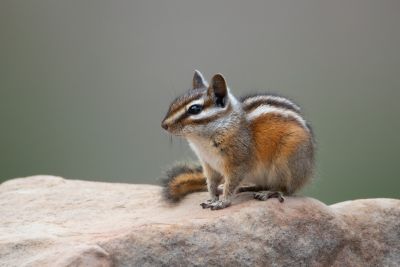
Neotamias cinereicollis photographed by Michael Stremciuc in Coconino National Forest, Arizona. -

Gray-footed Chipmunk (Neotamias canipes) photographed by CK2AZ in Lincoln National Forest, Cloudcroft, New Mexico.
Comparison with Neotamias dorsalis
From Hilton and Best (1993): "The skull of the gray-collared chipmunk is similar to that of dorsalis, except that the braincase of cinereicollis is shorter and broader, the rostrum is shorter and more depressed, and the incisors are narrower than in dorsalis (Mearns, 1907)."
-
Neotamias cinereicollis photographed by Michael Stremciuc in Coconino National Forest, Arizona. -

Cliff Chipmunk (Neotamias dorsalis) photographed by Rick Overson in the Superstition Mountains of Arizona.
Comparison with Neotamias minimus
From Hilton and Best (1993): "The gray-collared chipmunk is grayer than minimus, especially on the shoulders and cheeks, whereas minimus is buffy gray. It also differs from minimus in having a greater postorbital breadth (minimus, ≤ 10.8 mm with no overlap) and cranial depth (minimus, ≤ 13.7 mm with no overlap). Externally, cinereicollis and minimus are difficult to distinguish (Hoffmeister, 1986)."
-
Neotamias cinereicollis photographed by Michael Stremciuc in Coconino National Forest, Arizona. -

Least Chipmunk (Neotamias minimus) photographed by whitemudwayne at the University Of Alberta Farm in Edmonton, Alberta, Canada. Summer pelage is brighter than grayish winter pelage.
Comparison with Neotamias quadrivittatus
From Hilton and Best (1993): "Compared with quadrivittatus, palatilar length and post-orbital breadth of cinereicollis are larger on average, and cinereicollis is gray on the shoulders rather than orange (Hoffmeister, 1986)."
-
Neotamias cinereicollis photographed by Michael Stremciuc in Coconino National Forest, Arizona. -
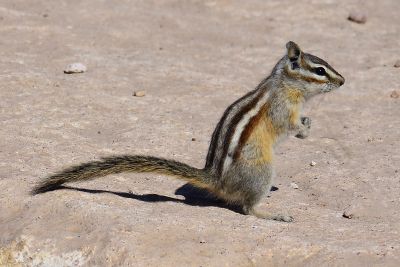
Colorado Chipmunk (Neotamias quadrivittatus) observed by Ad Konings in Saguache County, Colorado.
Comparison with Neotamias umbrinus
From Hilton and Best (1993): "Compared with umbrinus, postpalatal length is smaller and total length, palatilar length, zygomatic breadth, and length of maxillary toothrow are larger for cinereicollis (Hoffmeister, 1986). Five well-defined black dorsal stripes and four pale stripes distinguish cinereicollis from dorsalis and merriami, which have ambiguous or obscure dorsal stripes."
-
Neotamias cinereicollis photographed by Michael Stremciuc in Coconino National Forest, Arizona. -

Uinta Chipmunk (Neotamias umbrinus)
References
Bailey V. 1902. Seven new mammals from western Texas, Proceedings of the Biological Society of Washington, 15:117-120.
Hall ER. 1981. The mammals of North America. 2 vols. John Wiley and Sons, New York.
Hilton CD, Best TL. 1993. Tamias cinereicollis. Mammalian Species (436):1-5. https://doi.org/10.2307/3504235
Hoffmeister DF. 1986. Mammals of Arizona. Tucson (AZ, USA): University of Arizona Press.
Howell AH. 1929. Revision of the American chipmunks (genera Tamias and Eutamis). North American Fauna 52:1-157.
Mearns EA. 1907. Mammals of the Mexican boundary of the United States: a descriptive catalogue of the species of mammals occurring in that region; with a general summary of the natural history, and a list of trees. Bulletin of the United States National Museum 56: 1-530.
Sutton DA. 1992. Tamias amoenus. Mammalian Species (390):1-8.