Urocitellus parryii
| Arctic Ground Squirrel
(Urocitellus parryii) | |
|---|---|
| Range | |
 | |
| Taxonomic classification | |
| Order: | Rodentia |
| Suborder: | Sciuromorpha |
| Family: | Sciuridae |
| Subfamily: | Xerinae |
| Tribe: | Marmotini |
| Genus: | Urocitellus |
| Binomial details | |
| Urocitellus parryii (J. Richardson, 1825) | |
| Other resources | |
| Full taxonomic details at MDD | |
The Arctic Ground Squirrel (Urocitellus parryii) is the largest species in the genus Urocitellus. From McLean (2018): "Urocitellus parryii is the northernmost species within the family Sciuridae and the only sciurid with a Holarctic distribution. A quintessential high-latitude mammal."
Description
From McLean (2018): "In pelage, U. parryii is the most intensely and variably colored of its congeners (except possibly U. columbianus, Columbian ground squirrel). The dorsum varies in color from pale buff or grizzled buff to ochre or rich chestnut and is more deeply colored than the unmarked venter, being noticeably flecked with white spots in all color phases. U. parryii has a more colorful head than body, with forehead darker than cheeks; shoulders, forelimbs, and hindlimbs that are unmarked but more colorfully washed than the venter; and a relatively long-haired tail that is grizzled or dark above and buffy, ochre or reddish below." McLean (2018) also notes that Urocitellus parryii is the largest species in the genus Urocitellus.


Museum specimens
-

Holotype: USNM 119815. Urocitellus parryii ablusus. Adult male. Nushagak, Alaska, Collected 16 September 1902. -

Holotype: USNM 119815. Urocitellus parryii ablusus. Adult male. Nushagak, Alaska, Collected 16 September 1902.


External measurements
Length measurements are in millimeters (mm) and weight measurements are in grams (g), unless stated otherwise. If available, the sample size (n=) is provided. If a range is not provided and n= is not given, then the listed measurement represents an average.
| Part of range | Reference | Total length | Tail length | Hindfoot length | Ear length | Mass |
|---|---|---|---|---|---|---|
| Alaska (southeastern) and Yukon Territory (southern) and British Columbia | McLean (2018) | 300–363 | 85–105 | 50–57 | ||
| mainland subspecies excluding southeastern Alaska and southern Yukon Territory and British Columbia | McLean (2018) | 340–495 | 88–165 | 52–68 | ||
| rangewide | McLean (2018) | 10–21 | 450–1,000 |
Color variation
This section shows some of the color variation present in Urocitellus parryii. The location is provided for reference only. The individual shown does not necessarily represent the only color variant within the local population.
-

Arctic Ground Squirrel (Urocitellus parryii) photographed by Steve Hillebrand/USFWS. -

Arctic Ground Squirrel (Urocitellus parryii) photographed by Lynda Lybeck-Robinson in Unalaska, Alaska. -
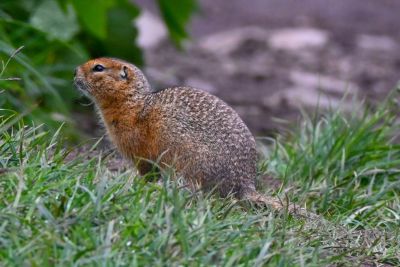
Arctic Ground Squirrel (Urocitellus parryii) photographed by frogbandit in Anchorage, Alaska. -

Arctic Ground Squirrel (Urocitellus parryii) photographed by Dean Hester in Denali Borough, Alaska. -
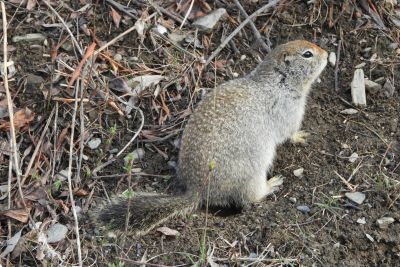
Arctic Ground Squirrel (Urocitellus parryii) photographed by luisag1996 in Denali Borough, Alaska. -

Arctic Ground Squirrel (Urocitellus parryii) photographed by Ryan Sealy in Yukon, Canada.


Skull
-

Holotype: USNM 119815. Urocitellus parryii ablusus. Adult male. Nushagak, Alaska, Collected 16 September 1902. Dorsal view of the skull. -

Holotype: USNM 119815. Urocitellus parryii ablusus. Adult male. Nushagak, Alaska, Collected 16 September 1902. Ventral view of the skull. -

Holotype: USNM 119815. Urocitellus parryii ablusus. Adult male. Nushagak, Alaska, Collected 16 September 1902. Lateral view of the skull. -

Holotype: USNM 119815. Urocitellus parryii ablusus. Adult male. Nushagak, Alaska, Collected 16 September 1902. Dorsal view of the mandible. -

Holotype: USNM 119815. Urocitellus parryii ablusus. Adult male. Nushagak, Alaska, Collected 16 September 1902. Lateral view of the left mandible.


Similar species
The range of Urocitellus parryii does not overlap with that of any other species of Urocitellus. The closest species (in range) is the Columbian Ground Squirrel (Urocitellus columbianus).
Comparison with Urocitellus columbianus
From McLean (2018): "From U. columbianus, it can be distinguished primarily by its more buffy (and less reddish) coloration, but U. parryii also averages slightly larger than U. columbianus in total length (245 versus 233 mm, respectively) and tail length (55 versus 50 mm, respectively)."
| Species | Subgroup | Total length | Greatest length of skull | Measurement reference |
|---|---|---|---|---|
| Urocitellus columbianus | big-eared | 325–410 mm | 51.7 mm (ssp. ruficaudus) | Elliot and Flinders (1991) |
| Urocitellus parryii | big-eared | 300–495 mm | 53.2–65.8 mm | McLean (2018) |
-

Columbian Ground Squirrel (Urocitellus columbianus) photographed by Andrey Atuchin in Kananaskis, Alberta, Canada. This is a big-eared species. It is one of the largest and most richly colored species in the genus Urocitellus. -
Arctic Ground Squirrel (Urocitellus parryii) photographed by Ryan Sealy in the Yukon Territory, Canada. This is a big-eared species that is intensely and variably colored. The dorsal pelage is noticeably flecked with white spots. This is the largest species in the genus Urocitellus.
References
McLean BS. 2018. Urocitellus parryii (Rodentia: Sciuridae). Mammalian Species 50(964): 84-99. https://doi.org/10.1093/mspecies/sey011
Richardson J. 1825. Account of the quadrupeds and birds. Pp. 287–379 in Anonymous. (eds.). Appendix to Captain Parry's Journal of a Second Voyage for the Discovery of a North-West Passage from the Atlantic to the Pacific, performed in His Majesty's Ships Fury and Hecla, in the Years 1821-22-23. John Murray, London, 432 pp.