Urocitellus elegans
| Wyoming Ground Squirrel
(Urocitellus elegans) | |
|---|---|
| Range | |
 | |
| Taxonomic classification | |
| Order: | Rodentia |
| Suborder: | Sciuromorpha |
| Family: | Sciuridae |
| Subfamily: | Xerinae |
| Tribe: | Marmotini |
| Genus: | Urocitellus |
| Binomial details | |
| Urocitellus elegans (Kennicott, 1863) | |
| Other resources | |
| Full taxonomic details at MDD | |
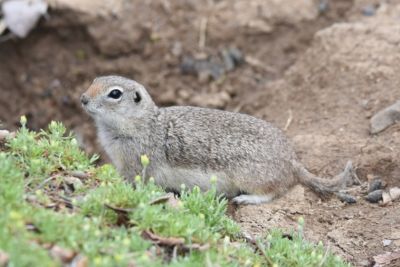
The Wyoming Ground Squirrel (Urocitellus elegans) is a medium-sized ground squirrel that occupies grasslands and semi-desert shrublands.
Description
From Armstrong (2010): "This is a medium-sized ground squirrel with a fairly long tail. The upperparts are drab buffy gray. A few individuals may show a slight dappling of blackish hairs. The underparts are buff to grayish. The tail is grayish to pale brown beneath and has a broad edge of white or buff."
From Zegers (1984): "a big-eared ground squirrel (sensu Nadler, 1966) of small to medium size with a relatively long tail... Upperparts are light drab and flecked with light pinkish buff, clay color, or pinkish cinnamon. The tail is edged with pale buff or white; the underside of the tail is clay colored, buff, or light brown (Hall, 1981; Howell, 1938)."


Museum images
-

Syntype: USNM 3479/4810. Urocitellus elegans elegans. Skin and skull. Female. Fort Bridger, Camp Scott, Uinta County, Wyoming. Collected 17 April 1858. -

Syntype: USNM 3479/4810. Urocitellus elegans elegans. Skin and skull. Female. Fort Bridger, Camp Scott, Uinta County, Wyoming. Collected 17 April 1858.


External measurements
Length measurements are in millimeters (mm) and weight measurements are in grams (g), unless stated otherwise. If available, the sample size (n=) is provided. If a range is not provided and n= is not given, then the listed measurement represents an average.
| Part of range | Reference | Total length | Tail length | Hindfoot length | Ear length | Mass |
|---|---|---|---|---|---|---|
| Colorado | Hall (1981) | 250–335 | 65–100 | 39–49 | 300–500 | |
| Oregon | Verts & Carraway (1998) | females: 290–295 (n=2); male: 315 (n=1) | females: 42–44 (n=2); male: 48 (n=1) | female: 453.6 (n=1) |
Color variation
This section shows some of the color variation present in Urocitellus elegans. The location is provided for reference only. The individual shown does not necessarily represent the only color variant within the local population.
-

Wyoming Ground Squirrel (Urocitellus elegans) photographed by wyattherp in Grand County, Colorado. -

Wyoming Ground Squirrel (Urocitellus elegans) photographed by Van Remsen in Albany County, Wyoming. -

Wyoming Ground Squirrel (Urocitellus elegans) photographed by Tom Benson in Gunnison County, Colorado. -

Wyoming Ground Squirrel (Urocitellus elegans) photographed by frannysopranny in Boars Tusk, Wyoming. -

A young Wyoming Ground Squirrel (Urocitellus elegans) photographed by shmugrizzle in Larimer County, Colorado. -

Wyoming Ground Squirrel (Urocitellus elegans) photographed by Matthew Moskwik in Lake View, Montana. This individual is assumed to be elegans based on location. -

Wyoming Ground Squirrel (Urocitellus elegans) photographed by Greg Lasley in Red Rocks Lake National Wildlife Refuge, Montana.


Skull
From Verts and Carraway (1998): "The skull of elegans is similar to that of other ground squirrels in that the zygomata are twisted, flattened dorsoventrally, and converge anteriorly. Characters of skulls of elegans overlap those of sympatric congeners such that they are of little value in identifying species."
-

Syntype: USNM 5950/4814. Urocitellus elegans elegans. Fort Bridger, Uinta County, Wyoming. Collected 1858. Dorsal view of the skull. -

Syntype: USNM 5950/4814. Urocitellus elegans elegans. Fort Bridger, Uinta County, Wyoming. Collected 1858. Ventral view of the skull. -

Syntype: USNM 5950/4814. Urocitellus elegans elegans. Fort Bridger, Uinta County, Wyoming. Collected 1858. Lateral view of the skull. -

Syntype: USNM 5950/4814. Urocitellus elegans elegans. Fort Bridger, Uinta County, Wyoming. Collected 1858. Dorsal view of the mandible. -

Syntype: USNM 5950/4814. Urocitellus elegans elegans. Fort Bridger, Uinta County, Wyoming. Collected 1858. Lateral view of the left mandible.


Similar species
Comparison with prairie dogs (genus: Cynomys)
Urocitellus ground squirrels are sometimes confused with prairie dogs (genus: Cynomys). Urocitellus ground squirrels can be distinguished from prairie dogs by their smaller body size, smaller skull, and pelage coloration. Prairie dogs generally have more uniform, buff or tan coloration without much patterning. Please visit Cynomys for more detailed information on prairie dogs.
-
Wyoming Ground Squirrel (Urocitellus elegans) photographed by Van Remsen in Albany County, Wyoming. The upperparts are light drab and flecked or dappled with light pinkish buff, clay color, pinkish cinnamon, or blackish hairs. -

White-tailed Prairie Dog (Cynomys leucurus) observed by Liam Pentangelo in Jackson County, Colorado.
Comparison with Urocitellus armatus
From Zegers (1984): "Where sympatric with armatus, elegans is distinguishable by buff rather than gray underside of tail (Hall, 1981); in addition, elegans exhibits character displacement, being slightly smaller and paler than armatus where the two species are allopatric (Long, 1965)."
| Species | Subgroup | Total length | Greatest length of skull | Measurement reference |
|---|---|---|---|---|
| Urocitellus armatus | big-eared | 280–303 mm | 45.6–48.5 mm | Eshelman and Sonnemann (2000) |
| Urocitellus elegans | big-eared | 253–307 mm | 43.0–46.8 mm | Zegers (1984) |
-

Uinta Ground Squirrel (Urocitellus armatus) photographed by pirish761 in Yellowstone National Park, Wyoming. This is a big-eared species recognized by a crown sprinkled with gray and by cinnamon coloring on its head, front of face, and ears. Forelegs are cinnamon buff with pinkish shading towards forefeet. -
Wyoming Ground Squirrel (Urocitellus elegans) photographed by frannysopranny in Boars Tusk, Wyoming. This is a big-eared species with upperparts that are light drab and flecked or dappled with light pinkish buff, clay color, pinkish cinnamon, or blackish hairs.
Comparison with Urocitellus beldingi
From Zegers (1984): "Where sympatric with beldingi, elegans can be distinguished by its longer tail, more intense cinnamon coloration on nose and underparts, and buff rather than reddish color on underside of tail."
| Species | Subgroup | Total length | Greatest length of skull | Measurement reference |
|---|---|---|---|---|
| Urocitellus beldingi | big-eared | 230–300 mm | 41.3–46.3 mm | Jenkins and Eshelman (1984) |
| Urocitellus elegans | big-eared | 253–307 mm | 43.0–46.8 mm | Zegers (1984) |
-

Belding's Ground Squirrel (Urocitellus beldingi) photographed by Roger Woodruff in Tuolumne County, California. This is a big-eared species with a mid-dorsal area often is darker reddish-brown than the sides, although the conspicuousness of this trait varies geographically. -
Wyoming Ground Squirrel (Urocitellus elegans) photographed by wyattherp in Grand County, Colorado. This is a big-eared species with upperparts that are light drab and flecked or dappled with light pinkish buff, clay color, pinkish cinnamon, or blackish hairs. -

Holotype: USNM 186467. Urocitellus beldingi beldingi. Skin Adult female. Donner, Placer County, California. Collected 22 June 1886. -
Syntype: 3479/4810. Urocitellus elegans elegans. Skin and skull. Female. Fort Bridger, Camp Scott, Uinta County, Wyoming. Collected 17 April 1858.

Comparison with Urocitellus canus
The Merriam's Ground Squirrel (Urocitellus canus) differs from Urocitellus elegans by having dorsal pelage that is sharply separated from the lighter-colored pelage of the venter that extends high on the sides and shorter tail.
| Species | Subgroup | Total length | Greatest length of skull | Measurement reference |
|---|---|---|---|---|
| Urocitellus canus | small-eared | typically <250 mm | 34.6–38.7 mm (condylobasal length) | Cole and Wilson (2009) |
| Urocitellus elegans | big-eared | 253–307 mm | 43.0–46.8 mm | Zegers (1984) |
-
Merriam's Ground Squirrel (Urocitellus canus) photographed by Christopher Lindsey in Baker County, Oregon. This is a small-eared species. It is a gray ground squirrel with dorsal pelage that lacks spots or flecks. The sides of the head and the hind legs are tinted with pinkish to reddish buff. -
Wyoming Ground Squirrel (Urocitellus elegans) photographed by wyattherp in Grand County, Colorado. This is a big-eared species with upperparts that are light drab and flecked or dappled with light pinkish buff, clay color, pinkish cinnamon, or blackish hairs.
Comparison with Urocitellus richardsonii
From Elliott and Flinders (1991): "Live richardsonii and elegans cannot be distinguished reliably by pelage color (Fagerstone, 1982), but the longer, higher pitched churr calls and monosyllabic, pier cing chirp calls of the former are diagnostic (Fagerstone, 1982; Koeppl et al., 1978). [Urocitellus] richardsonii differs from elegans by having a body length greater than 275 mm, hindfeet 43 mm or longer, a maxillary toothrow greater than 10 mm, nasal length greater than 16 mm, and a maximum skull length greater than 45 mm (Howell, 1938). The baculum of richardsonii has a slightly twisted shaft and lacks distinct projections on the distal expansion, whereas that of elegans has a markedly twisted shaft and 8 to 11 tooth-like projections (Burt, 1960). The diploid chromosome number of richardsonii is 36, whereas 2n for elegans is 34 (Nadler et al., 1971)."
From Zegers (1984): "Where sympatric with richardsonii, elegans can be recognized by a hindfoot length less than 43 mm, total length less than 275 mm, a maxillary toothrow less than 10 mm, nasal length less than 17 mm, a greatest skull length 42 to 45 mm, and a zygomatic breadth less than 30 mm (Howell, 1938). In total body length, 11 of 16 cranial measurements, and 11 of 19 measurements of the axial skeleton, elegans is significantly smaller than richardsonii (Fagerstone, 1982). Although the dorsal side sometimes is more grayish or brownish and less buffy, the head and shoulders are paler and the tail is darker with paler edgings than in richardsonii (Howell, 1938), pelage color is not consistently different between elegans and richardsonii (Fagerstone, 1982)."
| Species | Subgroup | Total length | Greatest length of skull | Measurement reference |
|---|---|---|---|---|
| Urocitellus elegans | big-eared | 253–307 mm | 43.0–46.8 mm | Zegers (1984) |
| Urocitellus richardsonii | big-eared | 277–330 mm | 45.1–48.4 mm | Michener and Koeppl (1985); Hazard (1982) |
-
Wyoming Ground Squirrel (Urocitellus elegans) photographed by Greg Lasley in Red Rocks Lake National Wildlife Refuge, Montana. This is a big-eared species with upperparts that are light drab and flecked or dappled with light pinkish buff, clay color, pinkish cinnamon, or blackish hairs. -

Richardson's Ground Squirrel (Urocitellus richardsonii) photographed by Pia Odgaard in Alberta, Canada. This is a big-eared species with upperparts that are pinkish buff or cinnamon buff shaded with fuscous and the posterior part of the back showing a dappled effect. The sides of the head and neck and the fronts of the forelegs are cinnamon buff or clay colored.
Taxonomic notes
From Zegers (1984): "Before Howell (1938) grouped them together as Citellus richardsonii, S. elegans and S. richardsonii were considered distinct species. Differences in bacula (Burt, 1960), cranial morphology of living and fossil forms (Neuner, 1975; Robinson and Hoffmann, 1975), axial skeleton (Fagerstone, 1982), blood proteins (Nadler et al., 1974), fleas (Jellison, 1945), alarm calls (Fagerstone, 1982; Koeppl et al., 1978) and diploid number (Nadler et al., 1971) indicate that the two should be considered separate species."
References
Armstrong DM, Fitzgerald JP, Meaney CA. 2010. Mammals of Colorado, Second Edition. Denver (CO, USA): University Press of Colorado.
Burt WH. 1960. Bacula of North American mammals. Misc. Publ. Mus. Zool., Univ. Michigan, 113:5-7.
Fagerstone KA. 1987. Comparison of vocalizations between and within Spermophilus elegans elegans and S. richardsonii. Journal of Mammalogy 68(4):853-857.
Hall ER. 1981. The mammals of North America. 2 vols. New York (NY, USA): John Wiley and Sons.
Howell AH 1938. Revision of the North American ground squirrels, with a classification of the North American Sciuridae. North American Fauna 56:1-256.
Jellison WL. 1945. Siponaptera: the genus Oropsylla in North America. J. Parasitol. 31:83-97.
Kennicott R. 1863-10-27. Descriptions of four new species of Spermophilus, in the collections of the Smithsonian Institution. Proceedings of the Academy of Natural Sciences of Philadelphia 15:157-158.
Koeppl JW, Hoffmann RS, Nadler CF. 1978. Pattern analysis of acoustical behavior in four species of ground squirrels. Journal of Mammalogy 59:677-696.
Long CA. 1965. The mammals of Wyoming. University of Kansas Publications, Museum of Natural History 14:493-758.
Nadler CF. 1966. Chromosomes and systematics of American ground squirrels of the subgenus Spermophilus. Journal of Mammalogy 47(4):579-596.
Nadler CF, Hoffmann RS, Greer KR. 1971. Chromosomal divergence during evolution of ground squirrel populations (Rodentia: Spermophilus). Systematic Zoology, 20(3):298-305.
Nadler CF, Sukernik RI, Fomichova II, Hoffmann RS, Vorontsov NN. 1974. Evolution in ground squirrels-I. Transferrins in Holarctic populations of Spermophilus. Comparative Biochemistry and Physiology. Part A: Physiology, 47(2), pp.663-681.
Neuner AM. 1975. Evolution and distribution of the Spermophilus richardsonii complex of ground squirrels in the middle and late Pleistocene: a multivariate analysis. Unpubl. M.A. thesis, Univ. of Kansas, Lawrence.
Robinson JW, Hoffmann RS. 1975. Geographical and interspecific cranial variation in big-eared ground squirrels (Spermophilus): a multivariate study. Syst. Zool. 24:79-88.
Verts BJ, Carraway LN. 1998. Land mammals of Oregon. Berkeley (CA, USA): University of California Press.
Zegers DA. 1984. Spermophilus elegans. Mammalian Species (214):1-7. https://doi.org/10.2307/3503955