Urocitellus canus
| Merriam's Ground Squirrel
(Urocitellus canus) | |
|---|---|
| Range | |
 | |
| Taxonomic classification | |
| Order: | Rodentia |
| Suborder: | Sciuromorpha |
| Family: | Sciuridae |
| Subfamily: | Xerinae |
| Tribe: | Marmotini |
| Genus: | Urocitellus |
| Binomial details | |
| Urocitellus canus (C. H. Merriam, 1898) | |
| Other resources | |
| Full taxonomic details at MDD | |
The Merriam's Ground Squirrel (Urocitellus canus) is a small ground squirrel found primarily in sagebrush, grasslands, and pastures. Most of its geographic range is in Oregon.
Description
From Cole and Wilson (2009): "Urocitellus canus is a small, gray ground squirrel with short ears, a short, thin tail, and pelage lacking stripes, spots, or flecks. The fur is short and smooth (Bailey 1936). The darker, dorsal pelage is grayish washed with pinkish buff (Kays and Wilson 2002; Verts and Carraway 1998). The ventral pelage is light buff-white (Bailey 1936). The sides of the head and the hind legs are tinted with pinkish to reddish buff (Howell 1938; Kays and Wilson 2002). The tail is gray on the dorsal side and edged with buff. It is light cinnamon in color on the ventral side."


Museum specimens
-

Holotype: USNM 78681. Urocitellus canus. Adult female. Antelope, Wasco County, Oregon. Collected 21 June 1896. -
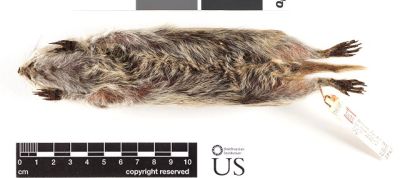
Holotype: USNM 78681. Urocitellus canus. Adult female. Antelope, Wasco County, Oregon. Collected 21 June 1896. -

Holotype: USNM 78681. Urocitellus canus. Adult female. Antelope, Wasco County, Oregon. Collected 21 June 1896.


External measurements
Length measurements are in millimeters (mm) and weight measurements are in grams (g), unless stated otherwise. If available, the sample size (n=) is provided. If a range is not provided and n= is not given, then the listed measurement represents an average.
| Part of range | Reference | Total length | Tail length | Hindfoot length | Ear length | Mass |
|---|---|---|---|---|---|---|
| rangewide | Cole and Wilson (2009) | males: 188–211; females: 193–218 | males: 33–49; females: 31–50 | males: 29–34; females: 30–32 | ||
| rangewide | Howell (1938) and Bailey (1936) in Cole and Wilson (2009) | 190–217 (n=10) | 37–42 (n=10) | 29–33 (n=10) |
Geographic variation and subspecies
Two subspecies are recognized: Urocitellus canus canus and Urocitellus canus vigilis. Most of the range is occupied by the grayer U. c. canus, while the browner S. c. vigilis occupies the Malheur and Snake river plains along the Oregon-Idaho border (Howell, 1938; Verts and Carraway, 1998; Cole and Wilson, 2009).
Skull
-

Holotype: USNM 78681. Urocitellus canus. Adult female. Antelope, Wasco County, Oregon. Collected 21 June 1896. Dorsal view of the skull. -

Holotype: USNM 78681. Urocitellus canus. Adult female. Antelope, Wasco County, Oregon. Collected 21 June 1896. Ventral view of the skull. -

Holotype: USNM 78681. Urocitellus canus. Adult female. Antelope, Wasco County, Oregon. Collected 21 June 1896. Lateral view of the skull. -

Holotype: USNM 78681. Urocitellus canus. Adult female. Antelope, Wasco County, Oregon. Collected 21 June 1896. Dorsal view of the mandible. -

Holotype: USNM 78681. Urocitellus canus. Adult female. Antelope, Wasco County, Oregon. Collected 21 June 1896. Lateral view of the left mandible.


Similar species
Species of Urocitellus that are sympatric with U. canus include: Belding's Ground Squirrel (Urocitellus beldingi), Columbian Ground Squirrel (Urocitellus columbianus), Wyoming Ground Squirrel (Urocitellus elegans), and the Piute Ground Squirrel (Urocitellus mollis). The Snake River appears to be a major biogeographic barrier, separating Urocitellus canus from the Idaho Ground Squirrel (Urocitellus brunneus) and the Snake River Plains Ground Squirrel (Urocitellus idahoensis) to the east (Yensen and Sherman, 1997; Cole and Wilson, 2009; McLean et al. 2025).
Comparison with Urocitellus beldingi
Urocitellus canus differs from the Belding's Ground Squirrel (Urocitellus beldingi) by having dorsal pelage that lacks a darker mid-dorsal band (although the conspicuousness of this trait varies geographically in beldingi), dorsal pelage that is sharply separated from the lighter-colored pelage of the venter that extends high on the sides, and by shorter ears that do not extend above the top of the head (Verts and Carraway, 1998).
| Species | Subgroup | Total length | Greatest length of skull | Measurement reference |
|---|---|---|---|---|
| Urocitellus beldingi | big-eared | 230–300 mm | 41.3–46.3 mm | Jenkins and Eshelman (1984) |
| Urocitellus canus | small-eared | typically <250 mm | 34.6–38.7 mm (condylobasal length) | Cole and Wilson (2009) |
-

Belding's Ground Squirrel (Urocitellus beldingi) photographed by Roger Woodruff in Tuolumne County, California. This is a big-eared species with a mid-dorsal area often is darker reddish-brown than the sides, although the conspicuousness of this trait varies geographically. -
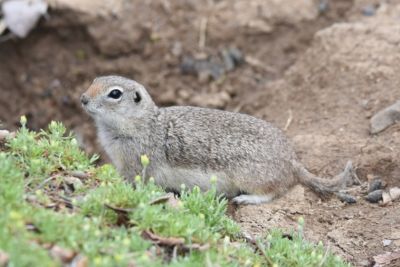
Merriam's Ground Squirrel (Urocitellus canus) photographed by Christopher Lindsey in Baker County, Oregon. This is a small-eared species. It is a gray ground squirrel with dorsal pelage that lacks spots or flecks. The sides of the head and the hind legs are tinted with pinkish to reddish buff.
Comparison with Urocitellus columbianus
The Columbian Ground Squirrel (Urocitellus columbianus) is one of the largest and most richly colored species in the genus Urocitellus. From Elliott and Flinders (1991): "columbianus differs from other species by having buffy dorsal spots and hind feet longer than 43 mm."
| Species | Subgroup | Total length | Greatest length of skull | Measurement reference |
|---|---|---|---|---|
| Urocitellus canus | small-eared | typically <250 mm | 34.6–38.7 mm (condylobasal length) | Cole and Wilson (2009) |
| Urocitellus columbianus | big-eared | 325–410 mm | 51.7 mm (ssp. ruficaudus) | Elliot and Flinders (1991) |
-
Merriam's Ground Squirrel (Urocitellus canus) photographed by Christopher Lindsey in Baker County, Oregon. This is a small-eared species. It is a gray ground squirrel with dorsal pelage that lacks spots or flecks. The sides of the head and the hind legs are tinted with pinkish to reddish buff. -

Columbian Ground Squirrel (Urocitellus columbianus) photographed by Andrey Atuchin in Kananaskis, Alberta, Canada. This is a big-eared species. It is one of the largest and most richly colored species in the genus Urocitellus.
Comparison with Urocitellus elegans
Urocitellus canus differs from the Wyoming Ground Squirrel (Urocitellus elegans) by having dorsal pelage that is sharply separated from the lighter-colored pelage of the venter that extends high on the sides and shorter tail.
| Species | Subgroup | Total length | Greatest length of skull | Measurement reference |
|---|---|---|---|---|
| Urocitellus canus | small-eared | typically <250 mm | 34.6–38.7 mm (condylobasal length) | Cole and Wilson (2009) |
| Urocitellus elegans | big-eared | 253–307 mm | 43.0–46.8 mm | Zegers (1984) |
-
Merriam's Ground Squirrel (Urocitellus canus) photographed by Christopher Lindsey in Baker County, Oregon. This is a small-eared species. It is a gray ground squirrel with dorsal pelage that lacks spots or flecks. The sides of the head and the hind legs are tinted with pinkish to reddish buff. -

Wyoming Ground Squirrel (Urocitellus elegans) photographed by wyattherp in Grand County, Colorado. This is a big-eared species with upperparts that are light drab and flecked or dappled with light pinkish buff, clay color, pinkish cinnamon, or blackish hairs.
Comparison with Urocitellus mollis
From McLean et al. (2025): "U. mollis may contact U. canus in the northeastern portion of its distribution (Cole and Wilson 2009), where the 2 species may be parapatrically distributed in northeastern Nevada, southeastern Oregon, and southwestern Idaho, but more surveys in this region are necessary." From Cole and Wilson (2009): "Urocitellus canus is not distinguishable from U. townsendii and U. mollis using external characteristics (Kays and Wilson 2002; Rickart 1999). These species are relatively small, have short, inconspicuous ears, short, thin tails, and their pelage is unmarked. The skull of canus is shorter and relatively broader than that of mollis (Howell 1938). The zygomata spread more widely, the bullae are generally smaller, and the rostrum is relatively shorter and broader compared to mollis."
| Species | Subgroup | Total length | Greatest length of skull | Measurement reference |
|---|---|---|---|---|
| Urocitellus canus | small-eared | typically <250 mm | 34.6–38.7 mm (condylobasal length) | Cole and Wilson (2009) |
| Urocitellus mollis | small-eared | 188 mm (holotype) | 33.4–38.6 mm (condylobasal length) | McLean (2025) |
-
Merriam's Ground Squirrel (Urocitellus canus) photographed by Christopher Lindsey in Baker County, Oregon. This is a small-eared species. It is a gray ground squirrel with dorsal pelage that lacks spots or flecks. The sides of the head and the hind legs are tinted with pinkish to reddish buff. -

Piute Ground Squirrel (Urocitellus mollis) photographed by Caleb Stroh in Box Elder County, Utah. This is a small-eared species. The upper parts are finely variegated silvery-gray, light yellowish-brown, and black; these colors are uniformly mixed throughout, without any indication of spots.
References
Bailey V. 1936. The mammals and life zones of Oregon. North American Fauna 55:1-416.
Cole FR, Wilson DE. 2009. Urocitellus canus (Rodentia: Sciuridae). Mammalian Species (834):1-8. https://doi.org/10.1644/834.1
Elliott CL, Flinders JT. 1991. Spermophilus columbianus. Mammalian species (372):1-9. https://doi-org.ezproxy1.lib.asu.edu/10.2307/3504178
Howell AH. 1938. Revision of the North American ground squirrels, with a classification of the North American Sciuridae. North American Fauna 56:1-25.
Kays RW, Wilson DE. 2009. Mammals of North America. Princeton (NJ, USA): Princeton University Press.
McLean BS, Rickart EA, Cook JA, Guralnick RP, Burgin CJ, Lohr K. 2025. Integrative species delimitation reveals an Idaho-endemic ground squirrel, Urocitellus idahoensis (Merriam 1913). Journal of Mammalogy (106) 405–429. https://doi.org/10.1093/jmammal/gyae135
Merriam CH. 1898-03-24. Descriptions of six new ground squirrels from the western United States. Proceedings of the Biological Society of Washington 12:69-71.
Rickart EA. 1999. Merriam's ground squirrel. P. 415 in The Smithsonian book of North American mammals (D. E. Wilson and S. Ruff, eds.). Washington DC (USA): Smithsonian Institution Press.
Verts BJ, Carraway LN. 1998. Land mammals of Oregon. Berkeley (CA, USA): University of California Press.