Urocitellus beldingi
| Belding's Ground Squirrel
(Urocitellus beldingi) | |
|---|---|
| Range | |
 | |
| Taxonomic classification | |
| Order: | Rodentia |
| Suborder: | Sciuromorpha |
| Family: | Sciuridae |
| Subfamily: | Xerinae |
| Tribe: | Marmotini |
| Genus: | Urocitellus |
| Binomial details | |
| Urocitellus beldingi (C. H. Merriam, 1888) | |
| Other resources | |
| Full taxonomic details at MDD | |
The Belding's Ground Squirrel (Urocitellus beldingi) is a medium-sized ground squirrel found in steppe and shrub-steppe habitats in the western United States.
Description
From Jenkins and Eshelman (1984): "a medium-sized ground squirrel with a relatively short tail, short limbs, and small ears. The pelage is gray, grading to cinnamon ventrally and to reddish-brown dorsally. There are three color bands (red, black, and white) on distal hairs of the tail (Davis, 1939; Turner, 1972). The mid-dorsal area often is darker reddish-brown than the sides, although the conspicuousness of this trait varies geographically (Davis, 1939; Hall, 1981)."


Museum specimens
-

Holotype: USNM 186467. Urocitellus beldingi beldingi. Skin Adult female. Donner, Placer County, California. Collected 22 June 1886. -

Holotype: USNM 186467. Urocitellus beldingi beldingi. Skin Adult female. Donner, Placer County, California. Collected 22 June 1886.


External measurements
Length measurements are in millimeters (mm) and weight measurements are in grams (g), unless stated otherwise. If available, the sample size (n=) is provided. If a range is not provided and n= is not given, then the listed measurement represents an average.
| Part of range | Reference | Total length | Tail length | Hindfoot length | Ear length | Mass |
|---|---|---|---|---|---|---|
| California | Jameson & Peeters (2004) | 268–296 | 60–75 | 42–47 | 9–10 | 126–305 |
| Oregon (elsewhere) | Verts & Carraway (1998) | females: 234–338 (n=34); males: 221–298 (n=29) | males:35–47 (n=29) | females: 174.6–346.0 (n=34); males: 182.1–455.2 (n=29) | ||
| Oregon (southeastern Harney and Malheur cos.) | Verts & Carraway (1998) | females: 255–302 (n=7); males: 255–300 (n=13) | females: 41–45 (n=7); males: 39–47 (n=13) | females: 241.3–429.6 (n=7); males: 265.0–365.3 (n=13) |
Skull
From Verts and Carraway (1998) comparing skulls of sympatric species of ground squirrels (note: taxonomic updates have been applied to this description): "The skull of beldingi is similar to that of other ground squirrels in the at the zygomata are twisted, flattened dorsoventrally, and converge anteriorly. It can be separated from that of the Urocitellus columbianus by having U-shaped temporal ridges and from Otospermophilus beecheyi by an angle parastyle ridge on M1 and M2. However, characters of skulls of Urocitellus canus, Urocitellus mollis [and presumably Urocitellus idahoensis as it was split from mollis by McLean et al. (2025)], Urocitellus elegans, Callospermophilus lateralis, and Urocitellus washingtoni overlap those of beldingi sufficiently to be of little value in distiguishing the latter species."
-

Holotype: USNM 186467. Urocitellus beldingi beldingi. Adult female. Donner, Placer County, California. Collected 22 June 1886. -

Holotype: USNM 186467. Urocitellus beldingi beldingi. Adult female. Donner, Placer County, California. Collected 22 June 1886. -

Holotype: USNM 186467. Urocitellus beldingi beldingi. Adult female. Donner, Placer County, California. Collected 22 June 1886. -

Holotype: USNM 186467. Urocitellus beldingi beldingi. Adult female. Donner, Placer County, California. Collected 22 June 1886. -

Holotype: USNM 186467. Urocitellus beldingi beldingi. Adult female. Donner, Placer County, California. Collected 22 June 1886.


Similar species
Members of Urocitellus that are sympatric with U. beldingi include: Uinta Ground Squirrel (Urocitellus armatus), Merriam's Ground Squirrel (Urocitellus canus), Columbian Ground Squirrel (Urocitellus columbianus), Wyoming Ground Squirrel (Urocitellus elegans), Snake River Plains Ground Squirrel (Urocitellus idahoensis), Piute Ground Squirrel (Urocitellus mollis), and Washington Ground Squirrel (Urocitellus washingtoni). The range of U. beldingi abuts that of the Idaho Ground Squirrel (Urocitellus brunneus), but the species are separated by the Snake River (Hall, 1981; Jenkins and Eshelman, 1984). U. beldingii and the Townsend's Ground Squirrel (Urocitellus townsendii) are separated by the Columbia River.
Comparison with Urocitellus armatus
From Eshelman and Sonnemann (2000): "A buff-colored tail with black above and below and edged with pinkish buff aids in distinguishing [Urocitellus] armatus from closely related ground squirrels. Underside of tail of armatus is gray, whereas... tail of beldingi is reddish underneath (Hall, 1981; Jenkins and Eshelman, 1984; Zeveloff, 1988)."
| Species | Subgroup | Total length | Greatest length of skull | Measurement reference |
|---|---|---|---|---|
| Urocitellus armatus | big-eared | 280–303 mm | 45.6–48.5 mm | Eshelman and Sonnemann (2000) |
| Urocitellus beldingi | big-eared | 230–300 mm | 41.3–46.3 mm | Jenkins and Eshelman (1984) |
-

Uinta Ground Squirrel (Urocitellus armatus) photographed by pirish761 in Yellowstone National Park, Wyoming. This is a big-eared species recognized by a crown sprinkled with gray and by cinnamon coloring on its head, front of face, and ears. Forelegs are cinnamon buff with pinkish shading towards forefeet. -

Belding's Ground Squirrel (Urocitellus beldingi) photographed by Roger Woodruff in Tuolumne County, California. This is a big-eared species with a mid-dorsal area often is darker reddish-brown than the sides, although the conspicuousness of this trait varies geographically. -
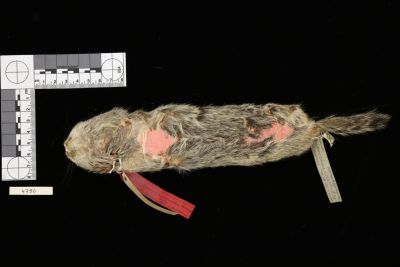
Syntype: MCZ:Mamm:4790. Urocitellus armatus. Female. Near Fort Bridger, foothills of Uinta Mountains, Camp Scott, Uinta County, Wyoming. Collected 26 May 1858. -
Holotype: USNM 186467. Urocitellus beldingi beldingi. Skin Adult female. Donner, Placer County, California. Collected 22 June 1886.

Comparison with Urocitellus canus
The Merriam's Ground Squirrel (Urocitellus canus) differs from Urocitellus beldingi by having dorsal pelage that lacks a darker mid-dorsal band (although the conspicuousness of this trait varies geographically in beldingi), dorsal pelage that is sharply separated from the lighter-colored pelage of the venter that extends high on the sides, and by shorter ears that do not extend above the top of the head (Verts and Carraway, 1998).
| Species | Subgroup | Total length | Greatest length of skull | Measurement reference |
|---|---|---|---|---|
| Urocitellus beldingi | big-eared | 230–300 mm | 41.3–46.3 mm | Jenkins and Eshelman (1984) |
| Urocitellus canus | small-eared | typically <250 mm | 34.6–38.7 mm (condylobasal length) | Cole and Wilson (2009) |
-

Belding's Ground Squirrel (Urocitellus beldingi) photographed by Marcus C. England in Jefferson County, Oregon. This is a big-eared species with a mid-dorsal area often is darker reddish-brown than the sides, although the conspicuousness of this trait varies geographically. -
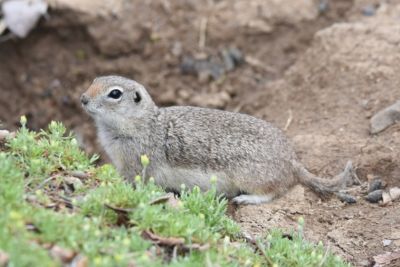
Merriam's Ground Squirrel (Urocitellus canus) photographed by Christopher Lindsey in Baker County, Oregon. This is a small-eared species. It is a gray ground squirrel with dorsal pelage that lacks spots or flecks. The sides of the head and the hind legs are tinted with pinkish to reddish buff.
Comparison with Urocitellus columbianus
From Elliott and Flinders (1991): "columbianus differs from other species by having buffy dorsal spots and hind feet longer than 43 mm."
| Species | Subgroup | Total length | Greatest length of skull | Measurement reference |
|---|---|---|---|---|
| Urocitellus beldingi | big-eared | 230–300 mm | 41.3–46.3 mm | Jenkins and Eshelman (1984) |
| Urocitellus columbianus | big-eared | 325–410 mm | 51.7 mm (ssp. ruficaudus) | Elliot and Flinders (1991) |
-
Belding's Ground Squirrel (Urocitellus beldingi) photographed by Roger Woodruff in Tuolumne County, California. This is a big-eared species with a mid-dorsal area often is darker reddish-brown than the sides, although the conspicuousness of this trait varies geographically. -

Columbian Ground Squirrel (Urocitellus columbianus) photographed by Andrey Atuchin in Kananaskis, Alberta, Canada. This is a big-eared species. It is one of the largest and most richly colored species in the genus Urocitellus. -
Belding's Ground Squirrel (Urocitellus beldingi) photographed by Roger Woodruff in Tuolumne County, California. This is a big-eared species with a mid-dorsal area often is darker reddish-brown than the sides, although the conspicuousness of this trait varies geographically. -

Wyoming Ground Squirrel (Urocitellus elegans) photographed by wyattherp in Grand County, Colorado. This is a big-eared species with upperparts that are light drab and flecked or dappled with light pinkish buff, clay color, pinkish cinnamon, or blackish hairs. -
Holotype: USNM 186467. Urocitellus beldingi beldingi. Skin Adult female. Donner, Placer County, California. Collected 22 June 1886. -

Syntype: 3479/4810. Urocitellus elegans elegans. Skin and skull. Female. Fort Bridger, Camp Scott, Uinta County, Wyoming. Collected 17 April 1858. -
Belding's Ground Squirrel (Urocitellus beldingi) photographed by Roger Woodruff in Tuolumne County, California. This is a big-eared species with a mid-dorsal area often is darker reddish-brown than the sides, although the conspicuousness of this trait varies geographically. -
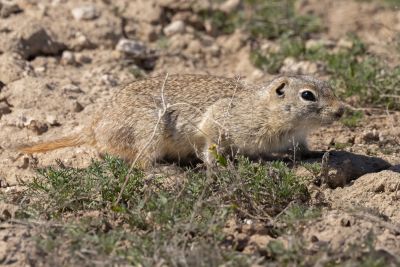
Snake River Plains Ground Squirrel (Urocitellus idahoensis) photographed by myworldofbirdphotography in Ada County, Idaho. This is a small-eared species. Dorsal color is variegated yellowish-brown with pale yellow dappling that is most distinct on rump but extending to shoulders in some individuals. Top of nose, outer surfaces of the lower hind legs, and underside of the tail are reddish-brown. -
Belding's Ground Squirrel (Urocitellus beldingi) photographed by Roger Woodruff in Tuolumne County, California. This is a big-eared species with a mid-dorsal area often is darker reddish-brown than the sides, although the conspicuousness of this trait varies geographically. -

Piute Ground Squirrel (Urocitellus mollis) photographed by Caleb Stroh in Box Elder County, Utah. This is a small-eared species. The upper parts are finely variegated silvery-gray, light yellowish-brown, and black; these colors are uniformly mixed throughout, without any indication of spots. -
Belding's Ground Squirrel (Urocitellus beldingi) photographed by Roger Woodruff in Tuolumne County, California. This is a big-eared species with a mid-dorsal area often is darker reddish-brown than the sides, although the conspicuousness of this trait varies geographically. -

Washington Ground Squirrel (Urocitellus washingtoni) photographed by TonyP PNW in Washington state. This is a small-eared species. The dorsum is flecked with grayish-white spots.
Comparison with Urocitellus elegans
The underside of the tail of the Wyoming Ground Squirrel (Urocitellus elegans) is ochraceous buff and lacks the black wash and pinkish edge; whereas the tail of Urocitellus beldingi is reddish underneath (from Eshelman and Sonnemann (2000) citing Hall, 1981; Jenkins and Eshelman, 1984; Zeveloff, 1988)."
| Species | Subgroup | Total length | Greatest length of skull | Measurement reference |
|---|---|---|---|---|
| Urocitellus beldingi | big-eared | 230–300 mm | 41.3–46.3 mm | Jenkins and Eshelman (1984) |
| Urocitellus elegans | big-eared | 253–307 mm | 43.0–46.8 mm | Zegers (1984) |

Comparison with Urocitellus idahoensis
According to McLean et al. (2025), the Snake River appears to be a major geographic barrier for the Snake River Plains Ground Squirrel (Urocitellus idahoensis), restricting the distribution of the species to north and east of the river. Jenkins and Eshelman (1984) provided the following distribution notes for Urocitellus beldingi: "Davis (1939) considered the Snake River as the northern boundary for the species in Idaho, but Durrant and Hansen (1954) reported beldingi north of the river."
| Species | Subgroup | Total length | Greatest length of skull | Measurement reference |
|---|---|---|---|---|
| Urocitellus beldingi | big-eared | 230–300 mm | 41.3–46.3 mm | Jenkins and Eshelman (1984) |
| Urocitellus idahoensis | small-eared | 188 mm (holotype for subspecies artemesiae); 263 mm (holotype for subspecies idahoensis) | 32.7–36.2 mm (condylobasal length for subspecies artemesiae); 36.2–39.0 (condylobasal length subspecies idahoensis) | McLean (2025) |
Comparison with Urocitellus mollis
| Species | Subgroup | Total length | Greatest length of skull | Measurement reference |
|---|---|---|---|---|
| Urocitellus beldingi | big-eared | 230–300 mm | 41.3–46.3 mm | Jenkins and Eshelman (1984) |
| Urocitellus mollis | small-eared | 188 mm (holotype) | 33.4–38.6 mm (condylobasal length) | McLean (2025) |
Comparison with Urocitellus washingtoni
The Washington Ground Squirrel (Urocitellus washingtoni) is smaller in size (length of hind foot <39 mm) than U. beldingi (Rickart and Yensen, 1991). Additionally, the dorsum of Urocitellus washington is flecked with grayish-white spots that are roughly square and 3-4 mm in breadth (Rickart and Yensen, 1991), whereas the dorsum of U. beldingi has no spotting or mottling on the back (Jenkins and Eshelman, 1984).
| Species | Subgroup | Total length | Greatest length of skull | Measurement reference |
|---|---|---|---|---|
| Urocitellus beldingi | big-eared | 230–300 mm | 41.3–46.3 mm | Jenkins and Eshelman (1984) |
| Urocitellus washingtoni | small-eared | 185–245 mm | 35.0–41.8 mm | Rickart and Yensen (1991) |
References
Davis WB. 1939. The Recent mammals of Idaho. Caldwell (ID, USA): Caxton Printers, Ltd.
Durrant SD, Hansen RM. 1954. Distribution patterns and phylogeny of some western ground squirrels. Syst. Zool. 3:82-85.
Elliott CL, Flinders JT.1984. Cranial measurements of the Columbian ground squirrel (Spermophilus columbianus columbianus), with special reference to subspecies taxonomy and juvenile skull development. The Great Basin Naturalist 44:505-508.
Eshelman BD, Sonnemann CS. 2000. Spermophilus armatus. Mammalian Species (637):1-6.
Hall ER. 1981. The mammals of North America. 2 vols. John Wiley and Sons, New York.
Jameson EW, Peeters HJ. 2004. Mammals of California (No. 66). Berkeley (CA, USA): University of California Press.
Jenkins SH, Eshelman BD. 1984. Spermophilus beldingi. Mammalian Species (221):1-8. https://doi.org/10.2307/3503911
McLean BS, Rickart EA, Cook JA, Guralnick RP, Burgin CJ, Lohr K. 2025. Integrative species delimitation reveals an Idaho-endemic ground squirrel, Urocitellus idahoensis (Merriam 1913). Journal of Mammalogy (106) 405–429. https://doi.org/10.1093/jmammal/gyae135
Merriam CH. 1888-12-28. Description of a new spermophile from California. Annals of the New York Academy of Sciences 4(1):317-321.
Rickart EA, Yensen E. 1991. Spermophilus washingtoni. Mammalian Species (371):1-5.
Turner LW. 1972. Autecology of the Belding ground squirrel in Oregon. Unpubl. Ph.D. dissert., Univ. Arizona, Tucson, 149 pp.
Verts BJ, Carraway LN. 1998. Land mammals of Oregon. Berkeley (CA, USA): University of California Press.
Zeveloff SI. 1988. Mammals of the Intermountain West. Salt Lake City (UT, USA): University of Utah Press.