Urocitellus idahoensis
| Snake River Plains Ground Squirrel
(Urocitellus idahoensis) | |
|---|---|
| Range | |
 | |
| Taxonomic classification | |
| Order: | Rodentia |
| Suborder: | Sciuromorpha |
| Family: | Sciuridae |
| Subfamily: | Xerinae |
| Tribe: | Marmotini |
| Genus: | Urocitellus |
| Binomial details | |
| Urocitellus idahoensis (C. H. Merriam, 1913) | |
| Other resources | |
| Full taxonomic details at MDD | |
The Snake River Plains Ground Squirrel (Urocitellus idahoensis) is a small ground squirrel endemic to the Snake River Plain in south-central Idaho. This species was split from Urocitellus mollis by McLean et al. (2025). From McLean et al. (2025): "species delimitation integrating multiple DNA sequence and morphological data sets supports specific recognition of the Idaho-endemic taxon U. idahoensis (Snake River Plains Ground Squirrel), distinguishing it from U. mollis (Piute ground squirrel) south of the Snake River."
Description
From McLean et al. (2025): "As in other small-eared Urocitellus, members of the species have a shorter tail (generally <60 mm) and hindfoot length (<39 mm) relative to body size in comparison to the long-eared clade and possess inconspicuous external pinnae. General dorsal color variegated yellowish-brown with pale yellow dappling that is most distinct on rump but extending to shoulders in some individuals. In subspecies artemesiae, dappling less distinct (pale markings fewer and smaller), along with in older individuals of idahoensis. Individual guard hairs dark gray basally, pale yellow mid-length, and black distally. Lateral and ventral surfaces grayish. Top of nose, outer surfaces of the lower hind legs, and underside of the tail are reddish-brown. Tail with a grayish-black subterminal patch (less distinct in artemesiae). The eye ring and anterior edge of the pinna are white. Feet yellowish-white."

Distribution
From McLean et al. (2025): "Endemic to the Snake River Plain in south-central Idaho between the Snake River and the Sawtooth Range, extending from Payette and Canyon counties east to Jefferson and Clark counties. The nominate subspecies, U. i. idahoensis, is distributed in the western Snake River Plain, from Payette County east to Elmore County. The subspecies U. i. artemesiae is distributed in the eastern Snake River Plain, from Clark County in the east to Gooding County in the west. The exact distributional limit between the 2 subspecies is currently uncertain, although it is likely in Elmore and Gooding counties. The Snake River appears to be a major biogeographic barrier for this species, separating it from U. mollis to the south and U. canus to the west. The nominate subspecies is also partially sympatric with the U. brunneus in Gem and Payette. Counties.
Museum specimens
-

Holotype: USNM 168290. Urocitellus idahoensis. Adult female. Payette, at junction of Payette and Snake River, Payette County, Idaho. Collected 23 April 1910. -

Holotype: USNM 168290. Urocitellus idahoensis. Adult female. Payette, at junction of Payette and Snake River, Payette County, Idaho. Collected 23 April 1910.


External measurements
Length measurements are in millimeters (mm) and weight measurements are in grams (g), unless stated otherwise. If available, the sample size (n=) is provided. If a range is not provided and n= is not given, then the listed measurement represents an average.
| Part of range | Reference | Total length | Tail length | Hindfoot length | Ear length | Mass |
|---|---|---|---|---|---|---|
| eastern portion of range (subspecies artemesiae) | McLean et al. (2025) | head and body: 154–174 | 40–53 | 30–33 | ||
| western portion of range (subspecies idahoensis) | McLean et al. (2025) | head and body: 175–185 | 40–62 | 34–39 |
Skull
-

Holotype: USNM 168290. Urocitellus idahoensis. Adult female. Payette, at junction of Payette and Snake River, Payette County, Idaho. Collected 23 April 1910. Dorsal view of the skull. -

Holotype: USNM 168290. Urocitellus idahoensis. Adult female. Payette, at junction of Payette and Snake River, Payette County, Idaho. Collected 23 April 1910. Ventral view of the skull. -

Holotype: USNM 168290. Urocitellus idahoensis. Adult female. Payette, at junction of Payette and Snake River, Payette County, Idaho. Collected 23 April 1910. Lateral view of the skull. -

Holotype: USNM 168290. Urocitellus idahoensis. Adult female. Payette, at junction of Payette and Snake River, Payette County, Idaho. Collected 23 April 1910. Dorsal view of the left mandible. -

Holotype: USNM 168290. Urocitellus idahoensis. Adult female. Payette, at junction of Payette and Snake River, Payette County, Idaho. Collected 23 April 1910. Lateral view of the left mandible.


Similar species
Comparison with Urocitellus armatus
| Species | Subgroup | Total length | Greatest length of skull | Measurement reference |
|---|---|---|---|---|
| Urocitellus armatus | big-eared | 280–303 mm | 45.6–48.5 mm | Eshelman and Sonnemann (2000) |
| Urocitellus idahoensis | small-eared | 188 mm (holotype for subspecies artemesiae); 263 mm (holotype for subspecies idahoensis) | 32.7–36.2 mm (condylobasal length for subspecies artemesiae); 36.2–39.0 (condylobasal length subspecies idahoensis) | McLean (2025) |
-

Uinta Ground Squirrel (Urocitellus armatus) photographed by pirish761 in Yellowstone National Park, Wyoming. This is a big-eared species recognized by a crown sprinkled with gray and by cinnamon coloring on its head, front of face, and ears. Forelegs are cinnamon buff with pinkish shading towards forefeet. -
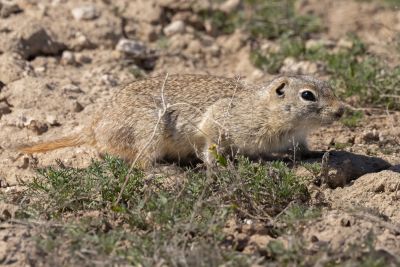
Snake River Plains Ground Squirrel (Urocitellus idahoensis) photographed by myworldofbirdphotography in Ada County, Idaho. This is a small-eared species. Dorsal color is variegated yellowish-brown with pale yellow dappling that is most distinct on rump but extending to shoulders in some individuals. Top of nose, outer surfaces of the lower hind legs, and underside of the tail are reddish-brown.
Comparison with Urocitellus beldingi
From Jenkins and Eshelman (1984): "Davis (1939) considered the Snake River as the northern boundary for the species [Belding's Ground Squirrel (Urocitellus beldingi)] in Idaho, but Durrant and Hansen (1954) reported beldingi north of the river."
| Species | Subgroup | Total length | Greatest length of skull | Measurement reference |
|---|---|---|---|---|
| Urocitellus beldingi | big-eared | 230–300 mm | 41.3–46.3 mm | Jenkins and Eshelman (1984) |
| Urocitellus idahoensis | small-eared | 188 mm (holotype for subspecies artemesiae); 263 mm (holotype for subspecies idahoensis) | 32.7–36.2 mm (condylobasal length for subspecies artemesiae); 36.2–39.0 (condylobasal length subspecies idahoensis) | McLean (2025) |
-

Belding's Ground Squirrel (Urocitellus beldingi) photographed by Roger Woodruff in Tuolumne County, California. This is a big-eared species with a mid-dorsal area often is darker reddish-brown than the sides, although the conspicuousness of this trait varies geographically. -
Snake River Plains Ground Squirrel (Urocitellus idahoensis) photographed by myworldofbirdphotography in Ada County, Idaho. This is a small-eared species. Dorsal color is variegated yellowish-brown with pale yellow dappling that is most distinct on rump but extending to shoulders in some individuals. Top of nose, outer surfaces of the lower hind legs, and underside of the tail are reddish-brown.
Comparison with Urocitellus brunneus
The ranges of Urocitellus idahoensis and the Idaho Ground Squirrel (Urocitellus brunneus) overlap in the vicinity of the Payette River in Gem and Payette Counties (McLean et al., 2025).
| Species | Subgroup | Total length | Greatest length of skull | Measurement reference |
|---|---|---|---|---|
| Urocitellus brunneus | small-eared* | 209–258 mm | 36.1–42.5 mm | Yensen and Sherman (1997) |
| Urocitellus idahoensis | small-eared | 188 mm (holotype for subspecies artemesiae); 263 mm (holotype for subspecies idahoensis) | 32.7–36.2 mm (condylobasal length for subspecies artemesiae); 36.2–39.0 (condylobasal length subspecies idahoensis) | McLean (2025) |
-

Idaho Ground Squirrel (Urocitellus brunneus) photographed by Yinan Li in Payette County, Idaho. This is a small, brownish, dorsally-spotted ground squirrel. -
Snake River Plains Ground Squirrel (Urocitellus idahoensis) photographed by myworldofbirdphotography in Ada County, Idaho. This is a small-eared species. Dorsal color is variegated yellowish-brown with pale yellow dappling that is most distinct on rump but extending to shoulders in some individuals. Top of nose, outer surfaces of the lower hind legs, and underside of the tail are reddish-brown.
Comparison with Urocitellus canus
From McLean et al. (2025): "The Snake River appears to be a major biogeographic barrier for this species, separating it from U. mollis to the south and U. canus to the west."
| Species | Subgroup | Total length | Greatest length of skull | Measurement reference |
|---|---|---|---|---|
| Urocitellus canus | small-eared | typically <250 mm | 34.6–38.7 mm (condylobasal length) | Cole and Wilson (2009) |
| Urocitellus idahoensis | small-eared | 188 mm (holotype for subspecies artemesiae); 263 mm (holotype for subspecies idahoensis) | 32.7–36.2 mm (condylobasal length for subspecies artemesiae); 36.2–39.0 (condylobasal length subspecies idahoensis) | McLean (2025) |
-
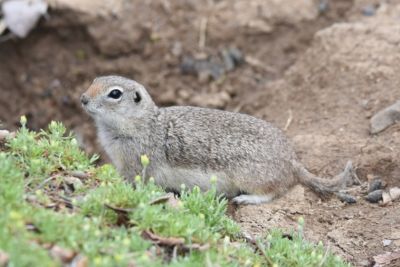
Merriam's Ground Squirrel (Urocitellus canus) photographed by Christopher Lindsey in Baker County, Oregon. This is a small-eared species. It is a gray ground squirrel with dorsal pelage that lacks spots or flecks. The sides of the head and the hind legs are tinted with pinkish to reddish buff. -
Snake River Plains Ground Squirrel (Urocitellus idahoensis) photographed by myworldofbirdphotography in Ada County, Idaho. This is a small-eared species. Dorsal color is variegated yellowish-brown with pale yellow dappling that is most distinct on rump but extending to shoulders in some individuals. Top of nose, outer surfaces of the lower hind legs, and underside of the tail are reddish-brown.
Comparison with Urocitellus mollis
From McLean et al. (2025): "Urocitellus mollis can be distinguished from both subspecies of U. idahoensis based on subtle pelage traits, including having no dappling (spotting) on their back and not having a subterminal patch on the tail. Both of these traits are less distinct in U. i. artemesiae, but are generally still present." However, "the Snake River appears to be a major biogeographic barrier for this species, separating it from U. mollis to the south and U. canus to the west."
| Species | Subgroup | Total length | Greatest length of skull | Measurement reference |
|---|---|---|---|---|
| Urocitellus idahoensis | small-eared | 188 mm (holotype for subspecies artemesiae); 263 mm (holotype for subspecies idahoensis) | 32.7–36.2 mm (condylobasal length for subspecies artemesiae); 36.2–39.0 (condylobasal length subspecies idahoensis) | McLean (2025) |
| Urocitellus mollis | small-eared | 188 mm (holotype) | 33.4–38.6 mm (condylobasal length) | McLean (2025) |
-
Snake River Plains Ground Squirrel (Urocitellus idahoensis) photographed by myworldofbirdphotography in Ada County, Idaho. This is a small-eared species. Dorsal color is variegated yellowish-brown with pale yellow dappling that is most distinct on rump but extending to shoulders in some individuals. Top of nose, outer surfaces of the lower hind legs, and underside of the tail are reddish-brown. -

Piute Ground Squirrel (Urocitellus mollis) photographed by Caleb Stroh in Box Elder County, Utah. This is a small-eared species. The upper parts are finely variegated silvery-gray, light yellowish-brown, and black; these colors are uniformly mixed throughout, without any indication of spots.
References
Davis WB. 1939. The Recent mammals of Idaho. Caldwell (ID, USA): Caxton Printers, Ltd.
Durrant SD, Hansen RM. 1954. Distribution patterns and phylogeny of some western ground squirrels. Syst. Zool. 3:82-85.
Jenkins SH, Eshelman BD. 1984. Spermophilus beldingi. Mammalian Species (221):1-8. https://doi.org/10.2307/3503911
Merriam CH. 1913-05-21. Six new ground squirrels of the Citellus mollis group from Idaho, Oregon, and Nevada. Proceedings of the Biological Society of Washington 26:135-138.
McLean BS, Rickart EA, Cook JA, Guralnick RP, Burgin CJ, Lohr K. 2025. Integrative species delimitation reveals an Idaho-endemic ground squirrel, Urocitellus idahoensis (Merriam 1913). Journal of Mammalogy (106) 405–429. https://doi.org/10.1093/jmammal/gyae135