Urocitellus mollis
| Piute Ground Squirrel
(Urocitellus mollis) | |
|---|---|
| Range | |
 | |
| Taxonomic classification | |
| Order: | Rodentia |
| Suborder: | Sciuromorpha |
| Family: | Sciuridae |
| Subfamily: | Xerinae |
| Tribe: | Marmotini |
| Genus: | Urocitellus |
| Binomial details | |
| Urocitellus mollis (Kennicott, 1863) | |
| Other resources | |
| Full taxonomic details at MDD | |
The Piute Ground Squirrel (Urocitellus mollis) is a small and small-eared ground squirrel that is widely distributed throughout much of the Great Basin.
Description
From McLean et al. (2025): "Kennicott’s (1863) original description of U. mollis focuses primarily on the external appearance of the species, stating: “Form rather stout, with the head small and the muzzle short and compressed. Ears rudimentary, the auricle only about one-twentieth of an inch high, and scarcely distinguishable in dried specimens. Feet rather large with the claws very weak, much compressed and considerably curved. Tail much flattened, the central hairs above and below short and closely appressed, the outer ones longer and distended laterally. The hair clothing and the body are remarkably fine and soft. The upper parts are finely variegated silvery-gray, light yellowish-brown, and black; these colors intimately and uniformly mixed throughout, without any indication of spots whatever. Under parts silvery-gray, with a slight wash of dirty creamy yellow. Tail above yellowish-brown, slightly mixed with black, with a distinct and prominent border and tip of white; beneath reddish-brown within the white border."


Distribution
From McLean et al. (2025): "Widely distributed throughout much of the Great Basin, including southern Idaho, southeastern Oregon, Nevada, northeastern and east-central California, and the western half of Utah. The northern limit of its distribution is marked by the Snake River, which separates the species from U. idahoensis in the north. U. mollis may contact U. canus in the northeastern portion of its distribution (Cole and Wilson 2009), where the 2 species may be parapatrically distributed in northeastern Nevada, southeastern Oregon, and southwestern Idaho, but more surveys in this region are necessary."

Museum specimens


External measurements
Length measurements are in millimeters (mm) and weight measurements are in grams (g), unless stated otherwise. If available, the sample size (n=) is provided. If a range is not provided and n= is not given, then the listed measurement represents an average.
| Part of range | Reference | Total length | Tail length | Hindfoot length | Ear length | Mass |
|---|---|---|---|---|---|---|
| California | Jameson & Peeters (2004) | 167–270 | 32–72 | 29–38 | 8–9 | |
| rangewide | McLean et al. (2025) | head and body: 156–193 | 45–60 | 32–37 |
Skull


Taxonomic notes
Urocitellus mollis was recently split by McLean et al. (2025). From McLean et al. (2025): "species delimitation integrating multiple DNA sequence and morphological data sets supports specific recognition of the Idaho-endemic taxon U. idahoensis (Snake River Plains Ground Squirrel), distinguishing it from U. mollis (Piute ground squirrel) south of the Snake River."
Similar species
Comparison with prairie dogs (genus: Cynomys) and marmots (genus: Marmota)
Urocitellus ground squirrels are sometimes confused with prairie dogs (genus: Cynomys) or marmots (genus: Marmota). Urocitellus ground squirrels can be distinguished from prairie dogs and marmots by their smaller body size, smaller skull, and pelage coloration. Prairie dogs generally have more uniform, buff or tan coloration without much patterning. The coat coloration of marmots is variable, but they are much larger ground squirrels with thick coats and bushy tails. Example images are provided below. Please visit each genus page for more detailed information on marmots and prairie dogs.
-

White-tailed Prairie Dog (Cynomys leucurus) observed by Liam Pentangelo in Jackson County, Colorado. -

Yellow-bellied Marmot (Marmota flaviventris) observed by Rick Overson and Laura Steger in Custer Gallatin National Forest, Montana.
Comparison with Urocitellus armatus
| Species | Subgroup | Total length | Greatest length of skull | Measurement reference |
|---|---|---|---|---|
| Urocitellus armatus | big-eared | 280–303 mm | 45.6–48.5 mm | Eshelman and Sonnemann (2000) |
| Urocitellus mollis | small-eared | 188 mm (holotype) | 33.4–38.6 mm (condylobasal length) | McLean (2025) |
-

Uinta Ground Squirrel (Urocitellus armatus) photographed by pirish761 in Yellowstone National Park, Wyoming. This is a big-eared species recognized by a crown sprinkled with gray and by cinnamon coloring on its head, front of face, and ears. Forelegs are cinnamon buff with pinkish shading towards forefeet. -

Piute Ground Squirrel (Urocitellus mollis) photographed by Caleb Stroh in Box Elder County, Utah. This is a small-eared species. The upper parts are finely variegated silvery-gray, light yellowish-brown, and black; these colors are uniformly mixed throughout, without any indication of spots.
Comparison with Urocitellus beldingi
| Species | Subgroup | Total length | Greatest length of skull | Measurement reference |
|---|---|---|---|---|
| Urocitellus beldingi | big-eared | 230–300 mm | 41.3–46.3 mm | Jenkins and Eshelman (1984) |
| Urocitellus mollis | small-eared | 188 mm (holotype) | 33.4–38.6 mm (condylobasal length) | McLean (2025) |
-

Belding's Ground Squirrel (Urocitellus beldingi) photographed by Roger Woodruff in Tuolumne County, California. This is a big-eared species with a mid-dorsal area often is darker reddish-brown than the sides, although the conspicuousness of this trait varies geographically. -
Piute Ground Squirrel (Urocitellus mollis) photographed by Caleb Stroh in Box Elder County, Utah. This is a small-eared species. The upper parts are finely variegated silvery-gray, light yellowish-brown, and black; these colors are uniformly mixed throughout, without any indication of spots.
Comparison with Urocitellus canus
From McLean et al. (2025): "U. mollis may contact U. canus in the northeastern portion of its distribution (Cole and Wilson 2009), where the 2 species may be parapatrically distributed in northeastern Nevada, southeastern Oregon, and southwestern Idaho, but more surveys in this region are necessary." From Cole and Wilson (2009): "Urocitellus canus is not distinguishable from U. townsendii and U. mollis using external characteristics (Kays and Wilson 2002; Rickart 1999). These species are relatively small, have short, inconspicuous ears, short, thin tails, and their pelage is unmarked. The skull of canus is shorter and relatively broader than that of mollis (Howell 1938). The zygomata spread more widely, the bullae are generally smaller, and the rostrum is relatively shorter and broader compared to mollis."
| Species | Subgroup | Total length | Greatest length of skull | Measurement reference |
|---|---|---|---|---|
| Urocitellus canus | small-eared | typically <250 mm | 34.6–38.7 mm (condylobasal length) | Cole and Wilson (2009) |
| Urocitellus mollis | small-eared | 188 mm (holotype) | 33.4–38.6 mm (condylobasal length) | McLean (2025) |
-
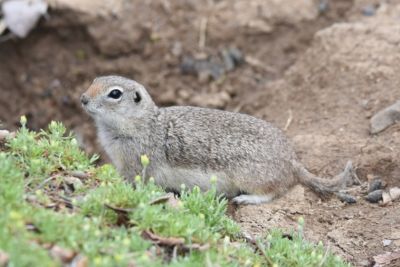
Merriam's Ground Squirrel (Urocitellus canus) photographed by Christopher Lindsey in Baker County, Oregon. This is a small-eared species. It is a gray ground squirrel with dorsal pelage that lacks spots or flecks. The sides of the head and the hind legs are tinted with pinkish to reddish buff. -
Piute Ground Squirrel (Urocitellus mollis) photographed by Caleb Stroh in Box Elder County, Utah. This is a small-eared species. The upper parts are finely variegated silvery-gray, light yellowish-brown, and black; these colors are uniformly mixed throughout, without any indication of spots.
Comparison with Urocitellus elegans
| Species | Subgroup | Total length | Greatest length of skull | Measurement reference |
|---|---|---|---|---|
| Urocitellus elegans | big-eared | 253–307 mm | 43.0–46.8 mm | Zegers (1984) |
| Urocitellus mollis | small-eared | 188 mm (holotype) | 33.4–38.6 mm (condylobasal length) | McLean (2025) |
-

Wyoming Ground Squirrel (Urocitellus elegans) photographed by Van Remsen in Albany County, Wyoming. This is a big-eared species with upperparts that are light drab and flecked or dappled with light pinkish buff, clay color, pinkish cinnamon, or blackish hairs. -
Piute Ground Squirrel (Urocitellus mollis) photographed by Caleb Stroh in Box Elder County, Utah. This is a small-eared species. The upper parts are finely variegated silvery-gray, light yellowish-brown, and black; these colors are uniformly mixed throughout, without any indication of spots.
Comparison with Urocitellus idahoensis
From McLean et al. (2025): "Urocitellus mollis can be distinguished from both subspecies of U. idahoensis based on subtle pelage traits, including having no dappling (spotting) on their back and not having a subterminal patch on the tail. Both of these traits are less distinct in U. i. artemesiae, but are generally still present.
| Species | Subgroup | Total length | Greatest length of skull | Measurement reference |
|---|---|---|---|---|
| Urocitellus idahoensis | small-eared | 188 mm (holotype for subspecies artemesiae); 263 mm (holotype for subspecies idahoensis) | 32.7–36.2 mm (condylobasal length for subspecies artemesiae); 36.2–39.0 (condylobasal length subspecies idahoensis) | McLean (2025) |
| Urocitellus mollis | small-eared | 188 mm (holotype) | 33.4–38.6 mm (condylobasal length) | McLean (2025) |
-
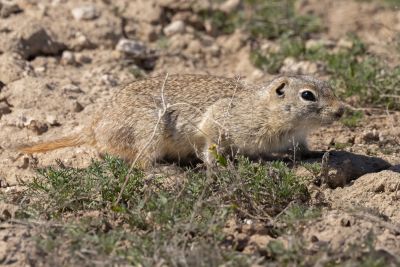
Snake River Plains Ground Squirrel (Urocitellus idahoensis) photographed by myworldofbirdphotography in Ada County, Idaho. This is a small-eared species. Dorsal color is variegated yellowish-brown with pale yellow dappling that is most distinct on rump but extending to shoulders in some individuals. Top of nose, outer surfaces of the lower hind legs, and underside of the tail are reddish-brown. -
Piute Ground Squirrel (Urocitellus mollis) photographed by Caleb Stroh in Box Elder County, Utah. This is a small-eared species. The upper parts are finely variegated silvery-gray, light yellowish-brown, and black; these colors are uniformly mixed throughout, without any indication of spots.
References
Cole FR, Wilson DE. 2009. Urocitellus canus (Rodentia: Sciuridae). Mammalian Species (834):1–8. https://doi.org/10.1644/834.1
Kennicott R. 1863. Descriptions of four new species of Spermophilus, in the collections of the Smithsonian Institution. Proceedings of the Academy of Natural Sciences of Philadelphia 15:157–158. https:// www.biodiversitylibrary.org/part/84767
McLean BS, Rickart EA, Cook JA, Guralnick RP, Burgin CJ, Lohr K. 2025. Integrative species delimitation reveals an Idaho-endemic ground squirrel, Urocitellus idahoensis (Merriam 1913). Journal of Mammalogy (106) 405–429. https://doi.org/10.1093/jmammal/gyae135