Urocitellus brunneus
| Idaho Ground Squirrel
(Urocitellus brunneus) | |
|---|---|
| Range | |
 | |
| Taxonomic classification | |
| Order: | Rodentia |
| Suborder: | Sciuromorpha |
| Family: | Sciuridae |
| Subfamily: | Xerinae |
| Tribe: | Marmotini |
| Genus: | Urocitellus |
| Binomial details | |
| Urocitellus brunneus (A. H. Howell, 1928) | |
| Other resources | |
| Full taxonomic details at MDD | |
The Idaho Ground Squirrel (Urocitellus brunneus) is a small ground squirrel endemic to Idaho and restricted to two relatively small areas in the western part of the state.
Description
From Yensen and Sherman (1997): "a small, brownish, dorsally-spotted ground squirrel with a short tail and medium-sized pinnae." Two subspecies are recognized. In subspecies brunneus (northern population), "the dorsal pelage appears dark reddish-gray as the result of a mixture of black unbanded and yellowish-red banded guard hairs. Juxtaposition of bands creates the small, rectangular, whitish-buff spots. The eye ring is buffy-white (Yensen, 1991)." In subspecies endemicus (southern population), "the dorsal coloration is grayish-brown as a result of less intense pigment in the banded guard hairs (Yensen, 1991). The legs and base of tail are russet and the underparts are grayish-white (Howell, 1938). The eye ring is creamy-white. Differences in dorsal coloration between [subspecies] brunneus and endemicus correspond to differences in soil color between their geographic ranges (Yensen, 1991)."


Museum specimens

Holotype: USNM 565927. Urocitellus brunneus endemicus. Female. Sand Hollow, Payette County, Idaho. Collected 30 March 1989. 
Holotype: USNM 565927. Urocitellus brunneus endemicus. Female. Sand Hollow, Payette County, Idaho. Collected 30 March 1989.


Distribution
Two subspecies of Urocitellus brunneus are described; Urocitellus brunneus brunneus and Urocitellus brunneus endemicus. The following distributions for each supspecies are provided by Yensen and Sherman (1997): subspecies "brunneus is endemic to west-central Idaho where it is known from 30 sites in Adams and Valley counties (as of 1997). These localities are in xeric montane meadows at 1150-1550 m elevation, and most are surrounded by coniferous forests. Twenty-one of the sites are in an area of 30 by 10 km (Yensen, 1991)... endemicus occurs in an area of 70 by 30 km in the low, rolling hills north of the Payette River at 670-975 m elevation in Gem, Payette, and Washington counties. The subspecies formerly occurred further north in a large basin in Washington County. The northernmost site where [Urocitellus brunneus] endemicus has been collected is 19 km S of the southernmost [Urocitellus brunneus] brunneus site. However, as of 1991, the two populations were separated by 48 km (Yensen, 1991)."
External measurements
Length measurements are in millimeters (mm) and weight measurements are in grams (g), unless stated otherwise. If available, the sample size (n=) is provided. If a range is not provided and n= is not given, then the listed measurement represents an average.
| Part of range | Reference | Total length | Tail length | Hindfoot length | Ear length | Mass |
|---|---|---|---|---|---|---|
| Idaho | Yensen (1991) in Yensen and Sherman (1997) | 209–258 (n=109) | 39–65 (n=109) | 32–39 (n=109) | 13–18 (109) |
Skull

Holotype: USNM 565927. Urocitellus brunneus endemicus. Female. Sand Hollow, Payette County, Idaho. Collected 30 March 1989. Dorsal view of the skull. 
Holotype: USNM 565927. Urocitellus brunneus endemicus. Female. Sand Hollow, Payette County, Idaho. Collected 30 March 1989. Ventral view of the skull. 
Holotype: USNM 565927. Urocitellus brunneus endemicus. Female. Sand Hollow, Payette County, Idaho. Collected 30 March 1989. Lateral view of the skull. 
Holotype: USNM 565927. Urocitellus brunneus endemicus. Female. Sand Hollow, Payette County, Idaho. Collected 30 March 1989. Lateral view of the mandible. 
Holotype: USNM 565927. Urocitellus brunneus endemicus. Female. Sand Hollow, Payette County, Idaho. Collected 30 March 1989. Dorsal view of the mandible.


Taxonomic notes
Support for recognition of subspecies endemicus as a distinct species
Recently, Hoisington-Lopez et al. (2012) elevated subspecies within U. brunneus, thereby recognizing Urocitellus endemicus as a distinct species. McLean et al. note the following in their 2025 publication: "These sister taxa are minimally diverged genetically (Hoisington-Lopez et al. 2012; McLean et al. 2016, 2022) but exhibit other differences (Yensen 1991; Hoisington-Lopez et al. 2012)." From Hoisington-Lopez et al. (2012): "Examination of our data sets suggests that, under the cohesion species concept, U. b. brunneus and U. b. endemicus could be treated as separate species. They are on separate evolutionary trajectories, because there is little to no migration between populations of these taxa, and apparently has not been gene flow since their late-Pleistocene divergence. Furthermore, they occupy different, nonoverlapping niches. Therefore, the 2 taxa exhibit neither demographic nor genetic exchangeability and conform well to the cohesion species concept. In addition, the 2 taxa differ greatly in morphology and behavior (Yensen 1991; Yensen and Sherman 1997), which further supports their status as distinct species." However, the American Society of Mammalogists' Mammal Diversity Database (June 22, 2025) retains endemicus as a subspecies of Urocitellus brunneus, providing "occasionally considered a distinct species, although this has not been followed in most subsequent publications and the data presented in the publication splitting the two species does not appear to strongly support a two species model."
Similar species
From Yensen and Sherman (1997): "Compared to congeners, brunneus is recognized by a combination of small size (head and body <200 mm, hind foot <40 mm); medium-sized pinnae (13-18 mm), short tail (39-65 mm); brownish dorsal coloration with light spots; rufous legs, nose, and ventral tail surface; and sharply contrasting off-white eye ring (Davis, 1939; Howell, 1938; Yensen, 1991)."
Comparison with Urocitellus armatus, U. beldingi, and U. elegans
Yensen and Sherman (1997) provide the following comparison of Urocitellus brunneus with the Uinta Ground Squirrel (Urocitellus armatus), Belding's Ground Squirrel (Urocitellus beldingi), and the Wyoming Ground Squirrel (Urocitellus elegans). However, the ranges of these species do not overlap with Urocitellus brunneus. The range of U. beldingi abuts that of U. brunneus, but the species are separated by the Snake River (Hall, 1981; Jenkins and Eshelman, 1984). From Yensen and Sherman (1997): "[Urocitellus] beldingi, [Urocitellus] elegans, and [Urocitellus] armatus are all larger (head plus body length >200 mm [excluding tail]), more gray-colored than brunneus, and are unspotted (Davis, 1939; Howell, 1938; Hall, 1981; Yensen, 1991)."
| Species | Subgroup | Total length | Greatest length of skull | Measurement reference |
|---|---|---|---|---|
| Urocitellus armatus | big-eared | 280–303 mm | 45.6–48.5 mm | Eshelman and Sonnemann (2000) |
| Urocitellus beldingi | big-eared | 230–300 mm | 41.3–46.3 mm | Jenkins and Eshelman (1984) |
| Urocitellus brunneus | small-eared* | 209–258 mm | 36.1–42.5 mm | Yensen and Sherman (1997) |
| Urocitellus elegans | big-eared | 253–307 mm | 43.0–46.8 mm | Zegers (1984) |
-

Uinta Ground Squirrel (Urocitellus armatus) photographed by pirish761 in Yellowstone National Park, Wyoming. This is a big-eared species recognized by a crown sprinkled with gray and by cinnamon coloring on its head, front of face, and ears. Forelegs are cinnamon buff with pinkish shading towards forefeet. -

Belding's Ground Squirrel (Urocitellus beldingi) photographed by Roger Woodruff in Tuolumne County, California. This is a big-eared species with a mid-dorsal area often is darker reddish-brown than the sides, although the conspicuousness of this trait varies geographically. -

Idaho Ground Squirrel (Urocitellus brunneus) photographed by Yinan Li in Payette County, Idaho. This is a small, brownish, dorsally-spotted ground squirrel. -

Wyoming Ground Squirrel (Urocitellus elegans) photographed by wyattherp in Grand County, Colorado. This is a big-eared species with upperparts that are light drab and flecked or dappled with light pinkish buff, clay color, pinkish cinnamon, or blackish hairs.
Comparison with Urocitellus columbianus
The Columbian Ground Squirrel (Urocitellus columbianus) is one of the largest and most richly colored species in the genus Urocitellus. From Elliott and Flinders (1991): "columbianus differs from other species by having buffy dorsal spots and hind feet longer than 43 mm." Yensen and Sherman (1997) state that Urocitellus brunneus is "distinguished from [Urocitellus] columbianus by its much smaller size (total length <258 mm vs. >320 mm), lack of rufous color on the throat, and less bushy, shorter tail <65 mm vs. >80 mm)."
| Species | Subgroup | Total length | Greatest length of skull | Measurement reference |
|---|---|---|---|---|
| Urocitellus brunneus | small-eared* | 209–258 mm | 36.1–42.5 mm | Yensen and Sherman (1997) |
| Urocitellus columbianus | big-eared | 325–410 mm | 51.7 mm (ssp. ruficaudus) | Elliot and Flinders (1991) |
-
Idaho Ground Squirrel (Urocitellus brunneus) photographed by Yinan Li in Payette County, Idaho. This is a small, brownish, dorsally-spotted ground squirrel. -

Columbian Ground Squirrel (Urocitellus columbianus) photographed by Andrey Atuchin in Kananaskis, Alberta, Canada. This is a big-eared species. It is one of the largest and most richly colored species in the genus Urocitellus.
Comparison with Urocitellus canus, U. idahoensis, U. mollis, and U. townsendii
The Townsend's Ground Squirrel (Urocitellus townsendii) once included several subspecies that are now recognized as distinct species, including the Merriam's Ground Squirrel (Urocitellus canus), Snake River Plains Ground Squirrel (Urocitellus idahoensis), and Piute Ground Squirrel (Urocitellus mollis). Yensen and Sherman (1997) provide the following comparison for U. townsendii (sensu lato—including former subspecies) and Urocitellus brunneus: "brunneus has much larger pinnae (13-18 vs. 6-9 mm), browner dorsal coloration, a spotted rather than flecked dorsum, less distinct lateral line, smaller auditory bullae, and a shorter, wider rostrum." The current ranges of the Townsend's Ground Squirrel (Urocitellus townsendii), Merriam's Ground Squirrel (Urocitellus canus), and the Piute Ground Squirrel (Urocitellus mollis) do not overlap with that of U. brunneus. The Snake River appears to be a major biogeographic barrier for this species, separating it from U. mollis to the south and U. canus to the west (McLean et al., 2025). The range of the Snake River Plains Ground Squirrel (Urocitellus idahoensis) and U. brunneus abut (and possibly overlap) in the vicinity of the Payette River in Gem and Payette Counties (McLean et al., 2025).
| Species | Subgroup | Total length | Greatest length of skull | Measurement reference |
|---|---|---|---|---|
| Urocitellus brunneus | small-eared* | 209–258 mm | 36.1–42.5 mm | Yensen and Sherman (1997) |
| Urocitellus canus | small-eared | typically <250 mm | 34.6–38.7 mm (condylobasal length) | Cole and Wilson (2009) |
| Urocitellus idahoensis | small-eared | 188 mm (holotype for subspecies artemesiae); 263 mm (holotype for subspecies idahoensis) | 32.7–36.2 mm (condylobasal length for subspecies artemesiae); 36.2–39.0 (condylobasal length subspecies idahoensis) | McLean (2025) |
| Urocitellus mollis | small-eared | 188 mm (holotype) | 33.4–38.6 mm (condylobasal length) | McLean (2025) |
| Urocitellus townsendii | small-eared | Museum help needed | Museum help needed |
-
Idaho Ground Squirrel (Urocitellus brunneus) photographed by Yinan Li in Payette County, Idaho. This is a small, brownish, dorsally-spotted ground squirrel. -
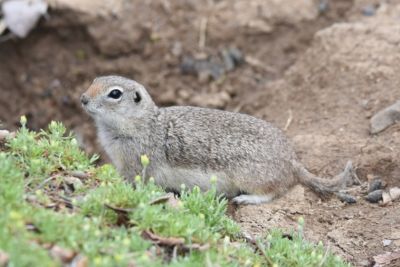
Merriam's Ground Squirrel (Urocitellus canus) photographed by Christopher Lindsey in Baker County, Oregon. This is a small-eared species. It is a gray ground squirrel with dorsal pelage that lacks spots or flecks. The sides of the head and the hind legs are tinted with pinkish to reddish buff. -
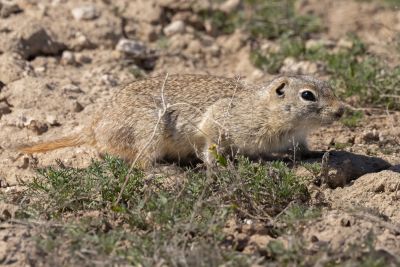
Snake River Plains Ground Squirrel (Urocitellus idahoensis) photographed by myworldofbirdphotography in Ada County, Idaho. This is a small-eared species. Dorsal color is variegated yellowish-brown with pale yellow dappling that is most distinct on rump but extending to shoulders in some individuals. Top of nose, outer surfaces of the lower hind legs, and underside of the tail are reddish-brown. -

Piute Ground Squirrel (Urocitellus mollis) photographed by Caleb Stroh in Box Elder County, Utah. This is a small-eared species. The upper parts are finely variegated silvery-gray, light yellowish-brown, and black; these colors are uniformly mixed throughout, without any indication of spots. -

Townsend's Ground Squirrel (Urocitellus townsendii) photographed by Dasha Gudalewicz in Washington state. This is a small-eared species with dorsal coloration that lacks spots.
Comparison with Urocitellus washingtoni
From Yensen and Sherman (1997): "Compared to [Urocitellus] washingtoni, brunneus has larger pinnae (13-18 vs. 10-13 mm), darker brown dorsal coloration, less distinct dorsal spots, less contrasting lateral line, and larger and more intensely pigmented rufous patches above the nose and on the thighs." The current ranges of these two species do not overlap.
| Species | Subgroup | Total length | Greatest length of skull | Measurement reference |
|---|---|---|---|---|
| Urocitellus brunneus | small-eared* | 209–258 mm | 36.1–42.5 mm | Yensen and Sherman (1997) |
| Urocitellus washingtoni | small-eared | 185–245 mm | 35.0–41.8 mm | Rickart and Yensen (1991) |
-
Idaho Ground Squirrel (Urocitellus brunneus) photographed by Yinan Li in Payette County, Idaho. This is a small, brownish, dorsally-spotted ground squirrel. -

Washington Ground Squirrel (Urocitellus washingtoni) photographed by TonyP PNW in Washington state. This is a small-eared species. The dorsum is flecked with grayish-white spots.
References
Davis WB. 1939. The Recent mammals of Idaho. Caldwell (ID, USA): Caxton Printers, Ltd.
Hall ER. 1981. The mammals of North America. 2 vols. New York (NY, USA): John Wiley and Sons.
Hoisington-Lopez JL, Waits LP, Sullivan J. 2012. Species limits and integrated taxonomy of the Idaho ground squirrel (Urocitellus brunneus): genetic and ecological differentiation. Journal of Mammalogy 93(2): 589-604.
Howell AH 1938. Revision of the North American ground squirrels, with a classification of the North American Sciuridae. North American Fauna 56:1-256.
Jenkins SH, Eshelman BD. 1984. Spermophilus beldingi. Mammalian Species (221):1-8. https://doi.org/10.2307/3503911
McLean BS, Bell KC, Cook JA. 2022. SNP-based phylogenomic inference in Holarctic ground squirrels (Urocitellus). Molecular Phylogenetics and Evolution 169:107396. https://doi.org/10.1016/j.ympev.2022.107396
McLean BS, Jackson DJ, Cook JA. 2016. Rapid divergence and gene flow at high latitudes shape the history of Holarctic ground squirrels (Urocitellus). Molecular Phylogenetics and Evolution 102:174–188. https://doi.org/10.1016/j.ympev.2016.05.040
McLean BS, Rickart EA, Cook JA, Guralnick RP, Burgin CJ, Lohr K. 2025. Integrative species delimitation reveals an Idaho-endemic ground squirrel, Urocitellus idahoensis (Merriam 1913). Journal of Mammalogy (106) 405–429. https://doi.org/10.1093/jmammal/gyae135
Hoisington-Lopez JL, Waits LP, Sullivan J. 2012. Species limits and integrated taxonomy of the Idaho ground squirrel (Urocitellus brunneus): genetic and ecological differentiation. Journal of Mammalogy 93(2): 589-604.
Urocitellus brunneus (ASM Mammal Diversity Database #1001788) fetched June 22, 2025. Mammal Diversity Database. 2025. https://www.mammaldiversity.org/taxon/1001788/
Yensen E, Luscher MP, Boyden S. 1991. Structure of burrows used by the Idaho ground squirrel, Spermophilus brunneus. Northwest Science 65:93-100.
Yensen E, Sherman PW. 1997. Spermophilus brunneus. Mammalian Species (560): 1-5. https://doi.org/10.2307/3504405